
Exam Name: Administering a SQL Database Infrastructure
Certification Provider: Microsoft
Corresponding Certification: MCSA SQL 2016

Over 58963+ Satisfied Customers
070-764 Online Test Engine
- Online Tool, Convenient, easy to study.
- 070-764 Practice Online Anytime
- Instant Online Access 070-764 Dumps
- Supports All Web Browsers
- Test History and Performance Review
- Supports Windows / Mac / Android / iOS, etc.
- Try Online Engine Demo
- Total Questions: 452
- Updated on: Nov 08, 2026
- Price: $69.00
070-764 Desktop Test Engine
- Installable Software Application
- Practice Offline Anytime
- Builds 070-764 Exam Confidence
- Simulates Real 070-764 Exam Environment
- Two Modes For 070-764 Practice
- Supports MS Operating System
- Software Screenshots
- Total Questions: 452
- Updated on: Nov 08, 2026
- Price: $69.00
070-764 PDF Practice Q&A's
- Printable 070-764 PDF Format
- Instant Access to Download 070-764 PDF
- Study Anywhere, Anytime
- Prepared by Microsoft Experts
- Free 070-764 PDF Demo Available
- 365 Days Free Updates
- Download Q&A's Demo
- Total Questions: 452
- Updated on: Nov 08, 2026
- Price: $69.00
Instant Download Microsoft : 070-764 Exam Dumps

Updated: Nov 08, 2026
No. of Questions: 452 Questions & Answers
Download Limit: Unlimited
Instant Download: Upon successful payment, Our systems will automatically send the product you have purchased to your mailbox by email. (If not received within 12 hours, please contact us. Note: don't forget to check your spam.)
100% Money Back Guarantee
ActualTestsIT has an unprecedented 99.6% first time pass rate among our customers.  We're so confident of our products that we provide no hassle product exchange.
- Best exam practice material
- Three formats are optional
- Learn anywhere, anytime
- 100% Safe shopping experience
- 10 years of excellence
- 365 Days Free Updates
Hard exam, pricey enrollment fee, weeks of preparation — the Microsoft Administering a SQL Database Infrastructure asks a lot before it gives anything back. ActualTestsIT balances the equation with 070-764 practice questions refined over nearly a decade of exam research.
Microsoft 070-764 Exam Syllabus Topics:
| Section | Weight | Objectives |
|---|---|---|
| Topic 1: Manage backup and restore of databases | 20–25% | - Develop backup strategy
|
| Topic 2: Manage and monitor SQL Server instances | 35–40% | - Monitor queries and performance
|
| Topic 3: Manage high availability and disaster recovery | 20–25% | - Implement disaster recovery
|
| Topic 4: Configure data access and auditing | 20–25% | - Configure auditing
|
Microsoft Administering a SQL Database Infrastructure FAQ: What You Need to Know
120–150 for 40–60 (approx.) questions — tighter than it looks once hard items start eating minutes. Train the pace now: assign each question a time budget, flag the stubborn ones, and run full timed sessions in the ActualTestsIT engine so test day feels like practice, not pressure.
4 domains make up the Microsoft Administering a SQL Database Infrastructure blueprint, led by Configure data access and auditing (20–25%), Manage and monitor SQL Server instances (35–40%), Manage backup and restore of databases (20–25%). The weights show where the vendor concentrates its questions — that's where your hours should concentrate too. The complete outline above details every subtopic.
Delivery is automatic: successful payment emails the product to your mailbox within a minute — install on unlimited computers, and if 2 hours pass with nothing (check spam first), contact us. If you fail: sit the corresponding 070-764 exam within 60 days of purchase, then submit a scanned enrollment slip and official Score Report PDF within 2 days of the exam — full refund, processed within 7 days. Excluded: exams taken within 3 days of purchase, name mismatches between candidate and payer, and free or expired products. Alternatively, exchange for two equal-value exam products free and keep your updates.
The 070-764 exam is Microsoft's official certification exam for the MCSA SQL 2016 credential, positioned at the Associate level. It has never been considered easy — which is precisely why it impresses employers. It also relates to MCSA: SQL 2016 Database Administration, MCSE: Data Management and Analytics.
The enrollment fee is USD 165 (approx.) — not cheap — and the passing score is 700 (scaled score). Since the fee applies in full to every attempt, each retake doubles down on the cost. The smarter sequence: drill the 452 practice questions from ActualTestsIT first, book the exam second.
Yes — hesitating is normal, and the free demo exists for exactly that. Download it, get a feel for the Microsoft Administering a SQL Database Infrastructure questions, and decide with confidence. Purchases include 365 days of free updates, with new versions announced by email; after expiry, renew at 50% off.
Recommended experience in SQL Server installation, configuration, maintenance, and database administration Rules like these do change — confirm the current criteria on the official exam page (official 070-764 exam page) before registering.
Microsoft Administering a SQL Database Infrastructure Sample Questions:
Overview
Application Overview
Contoso, Ltd., is the developer of an enterprise resource planning (ERP) application.
Contoso is designing a new version of the ERP application. The previous version of the ERP application used SQL Server 2008 R2.
The new version will use SQL Server 2014.
The ERP application relies on an import process to load supplier data. The import process updates thousands of rows simultaneously, requires exclusive access to the database, and runs daily.
You receive several support calls reporting unexpected behavior in the ERP application. After analyzing the calls, you conclude that users made changes directly to the tables in the database.
Tables
The current database schema contains a table named OrderDetails.
The OrderDetails table contains information about the items sold for each purchase order. OrderDetails stores the product ID, quantities, and discounts applied to each product in a purchase order.
The product price is stored in a table named Products. The Products table was defined by using the SQL_Latin1_General_CP1_CI_AS collation.
A column named ProductName was created by using the varchar data type. The database contains a table named Orders.
Orders contains all of the purchase orders from the last 12 months. Purchase orders that are older than 12 months are stored in a table named OrdersOld.
The previous version of the ERP application relied on table-level security.
Stored Procedures
The current version of the database contains stored procedures that change two tables. The following shows the relevant portions of the two stored procedures:
Customer Problems
Installation Issues
The current version of the ERP application requires that several SQL Server logins be set up to function correctly. Most customers set up the ERP application in multiple locations and must create logins multiple times.
Index Fragmentation Issues
Customers discover that clustered indexes often are fragmented. To resolve this issue, the customers defragment the indexes more frequently. All of the tables affected by fragmentation have the following columns that are used as the clustered index key:
Backup Issues
Customers who have large amounts of historical purchase order data report that backup time is unacceptable.
Search Issues
Users report that when they search product names, the search results exclude product names that contain accents, unless the search string includes the accent.
Missing Data Issues
Customers report that when they make a price change in the Products table, they cannot retrieve the price that the item was sold for in previous orders.
Query Performance Issues
Customers report that query performance degrades very quickly. Additionally, the customers report that users cannot run queries when SQL Server runs maintenance tasks. Import Issues During the monthly import process, database administrators receive many supports call from users who report that they cannot access the supplier data. The database administrators want to reduce the amount of time required to import the data.
Design Requirements
File Storage Requirements
The ERP database stores scanned documents that are larger than 2 MB. These files must only be accessed through the ERP application. File access must have the best possible read and write performance.
Data Recovery Requirements
If the import process fails, the database must be returned to its prior state immediately.
Security Requirements
You must provide users with the ability to execute functions within the ERP application, without having direct access to the underlying tables.
Concurrency Requirements
You must reduce the likelihood of deadlocks occurring when Sales.Prod and Sales.Proc2 execute.
You need to recommend a solution that addresses the index fragmentation and index width issue. What should you include in the recommendation? (Each correct answer presents part of the solution. Choose all that apply.)
- A. Change the data type of the id column to bigint.
- B. Remove the lastModified column from the clustered index.
- C. Remove the modifiedBy column from the clustered index.
- D. Remove the id column from the clustered index.
- E. Change the data type of the lastModified column to smalldatetime.
- F. Change the data type of the modifiedBy column to tinyint.
Correct Answer: B,C 🗳️
Explanation: Only visible for ActualTestsIT members. You can sign-up / login (it's free).
Overview
Application Overview
Contoso, Ltd., is the developer of an enterprise resource planning (ERP) application.
Contoso is designing a new version of the ERP application. The previous version of the ERP application used SQL Server 2008 R2.
The new version will use SQL Server 2014.
The ERP application relies on an import process to load supplier data. The import process updates thousands of rows simultaneously, requires exclusive access to the database, and runs daily.
You receive several support calls reporting unexpected behavior in the ERP application. After analyzing the calls, you conclude that users made changes directly to the tables in the database.
Tables
The current database schema contains a table named OrderDetails.
The OrderDetails table contains information about the items sold for each purchase order. OrderDetails stores the product ID, quantities, and discounts applied to each product in a purchase order.
The product price is stored in a table named Products. The Products table was defined by using the SQL_Latin1_General_CP1_CI_AS collation.
A column named ProductName was created by using the varchar data type. The database contains a table named Orders.
Orders contains all of the purchase orders from the last 12 months. Purchase orders that are older than 12 months are stored in a table named OrdersOld.
The previous version of the ERP application relied on table-level security.
Stored Procedures
The current version of the database contains stored procedures that change two tables. The following shows the relevant portions of the two stored procedures:
Customer Problems
Installation Issues
The current version of the ERP application requires that several SQL Server logins be set up to function correctly. Most customers set up the ERP application in multiple locations and must create logins multiple times.
Index Fragmentation Issues
Customers discover that clustered indexes often are fragmented. To resolve this issue, the customers defragment the indexes more frequently. All of the tables affected by fragmentation have the following columns that are used as the clustered index key:
Backup Issues
Customers who have large amounts of historical purchase order data report that backup time is unacceptable.
Search Issues
Users report that when they search product names, the search results exclude product names that contain accents, unless the search string includes the accent.
Missing Data Issues
Customers report that when they make a price change in the Products table, they cannot retrieve the price that the item was sold for in previous orders.
Query Performance Issues
Customers report that query performance degrades very quickly. Additionally, the customers report that users cannot run queries when SQL Server runs maintenance tasks. Import Issues During the monthly import process, database administrators receive many supports call from users who report that they cannot access the supplier data. The database administrators want to reduce the amount of time required to import the data.
Design Requirements
File Storage Requirements
The ERP database stores scanned documents that are larger than 2 MB. These files must only be accessed through the ERP application. File access must have the best possible read and write performance.
Data Recovery Requirements
If the import process fails, the database must be returned to its prior state immediately.
Security Requirements
You must provide users with the ability to execute functions within the ERP application, without having direct access to the underlying tables.
Concurrency Requirements
You must reduce the likelihood of deadlocks occurring when Sales.Prod and Sales.Proc2 execute.
You need to recommend a solution that addresses the security requirement. What should you recommend?
- A. Revoke user permissions on the tables. Create stored procedures that manipulate data. Grant the users the EXECUTE permission on the stored procedures.
- B. Deny the users the SELECT permission on the tables. Create stored procedures that manipulate data.
Grant the users the EXECUTE permission on the stored procedures. - C. Deny the users SELECT permission on the tables. Create views that retrieve data from the tables. Grant the users the SELECT permission on the views.
- D. Grant the users the SELECT permission on the tables. Create views that retrieve data from the tables.
Grant the users the SELECT permission on the views.
Correct Answer: C 🗳️
Explanation: Only visible for ActualTestsIT members. You can sign-up / login (it's free).
Note: This question is part of a series of questions that present the same scenario. Each question in the series contains a unique solution that might meet the stated goals. Some question sets might have more than one correct solution, while others might not have a correct solution.
After you answer a question in this section, you will NOT be able to return to it. As a result, these questions will not appear in the review screen.
A company has an on-premises Microsoft SQL Server environment and Microsoft Azure SQL Database instances. The environment hosts several customer databases.
One customer reports that their database is not responding as quickly as the service level agreements dictate.
You observe that the database is fragmented.
You need to optimize query performance.
Solution: You rebuild all indexes.
Does the solution meet the goal?
- A. No
- B. Yes
Correct Answer: B 🗳️
Explanation: Only visible for ActualTestsIT members. You can sign-up / login (it's free).
You use SQL Server 2014. You create a table within a database by using the following DDL:
The following table illustrates a representative sample of data:
The system is expected to handle 50 million orders a month over the next five years.
You have been instructed by your Team Lead to follow best practices for storage and performance in the utilization of SPARSE columns.
Which columns should you designate as SPARSE? To answer, mark each column as SPARSE or NOT SPARSE in the answer area.
Correct Answer:

Explanation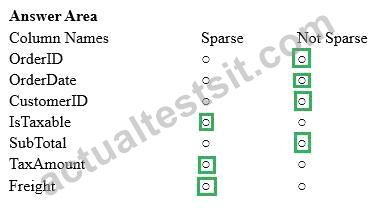
Sparse columns are ordinary columns that have an optimized storage for null values. Sparse columns reduce the space requirements for null values at the cost of more overhead to retrieve nonnull values. Consider using sparse columns when the space saved is at least 20 percent to 40 percent.
You have a SQL Server 2012 database named DB1.
You plan to import a large number of records from a SQL Azure database to DB1.
You need to recommend a solution to minimize the amount of space used in the transaction log during the import operation.
What should you include in the recommendation?
- A. a new log file
- B. a new filegroup
- C. the full recovery model
- D. the bulk-logged recovery model
- E. a new partitioned table
Correct Answer: D 🗳️
Explanation: Only visible for ActualTestsIT members. You can sign-up / login (it's free).
Viewing page 1 out of 91 pages.
Viewing questions 1-5 out of 452 questions.
 734 Customer ReviewsCustomers Feedback (* Some similar or old comments have been hidden.)
Oh my god, i just passed 070-764 exam with the passing score. Thank you so much! I truly studied not so hard for i had so many other things to deal with. I am so lucky.
Harvey

The credit of my success goes to none other than ActualTestsIT's unique content. I particularly appreciate the authenticity and preciseness of Passed 070-764 exam with brilliant grades!
Burke
The 070-764 training dump which is the latest also is the most valid and useful. I passed the exam with a high score. Never doubt about it! Just buy it!
Atalanta

I have purchased so many Microsoft exams from ActualTestsIT before and all of them are passed with high scores.I have passed, thanks a lot.
Lorraine
Your 070-764 dumps are valid.
Dawn
Passed Exam 070-764 without any hassle!
Best Solution for Passing 070-764 Exam!!!
Nigel
All are the real exams. just passed without any effort.
Delia
The dump is excellent. I passed first try with the dump. It's perfect. It covers everything you need to kmow for Microsoft 070-764 exam.
Kimberley
I managed to pass 070-764 on Monday with a score of 93% in Romania. I feel wonderful for it only took me less than 3 days to prapare for it.
Leona
The 070-764 exam dumps has many real questions and answers, you can't miss it.
Gloria
It proved that your MCSA SQL 2016 exam questions and answers are valid, thanks a lot.
Anna
Instant Download 070-764
After Payment, our system will send you the products you purchase in mailbox in a minute after payment. If not received within 2 hours, please contact us.
365 Days Free Updates
Free update is available within 365 days after your purchase. After 365 days, you will get 50% discounts for updating.

Money Back Guarantee
Full refund if you fail the corresponding exam in 60 days after purchasing. And Free get any another product.
Security & Privacy
We respect customer privacy. We use McAfee's security service to provide you with utmost security for your personal information & peace of mind.
