

Get New 2025 Valid Practice Microsoft Azure DP-300 Q&A - Testing Engine
DP-300 Dumps PDF - 100% Passing Guarantee
Microsoft DP-300 exam covers a wide range of topics related to administering relational databases on Azure, including designing and implementing Azure SQL database, securing and auditing data access, monitoring and optimizing database performance, and implementing high availability and disaster recovery solutions. Candidates must have a strong understanding of these topics and be able to apply their knowledge in real-world scenarios.
The DP-300 exam measures the candidate's knowledge and skills in various areas such as implementing security and auditing, managing Azure SQL database instances, configuring data access and replication, and monitoring and optimizing database performance. To prepare for the exam, candidates should have experience with Azure SQL database administration, knowledge of T-SQL, and familiarity with Azure services such as Azure Storage and Azure Active Directory.
The Microsoft DP-300 exam consists of various topics such as deploying Azure SQL Database, configuring data access and security, monitoring and optimizing databases, and implementing high availability and disaster recovery solutions. DP-300 exam is designed to test the ability of candidates in performing critical database administration tasks such as backup and restore operations, performance tuning, and troubleshooting. Passing the Microsoft DP-300 exam is an excellent way to demonstrate skills in administering and deploying relational databases on Microsoft Azure, which is a highly demanded skill in today's job market.
NEW QUESTION # 270
You have an Azure SQL database named db1 on a server named server1.
You use Query Performance Insight to monitor db1.
You need to modify the Query Store configuration to ensure that performance monitoring data is available as soon as possible.
Which configuration setting should you modify and which value should you configure? To answer, select the appropriate options in the answer area.
NOTE: Each correct selection is worth one point.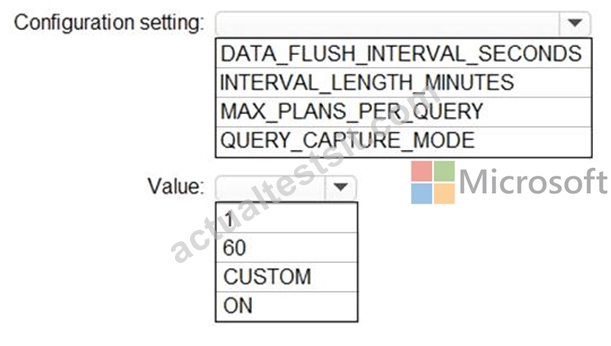
Answer:
Explanation: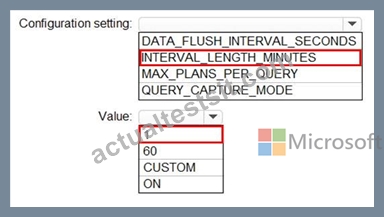
NEW QUESTION # 271
You have two on-premises Microsoft SQL Server 2019 instances named SQL1 and SQL2.
You need to migrate the databases hosted on SQL1 to Azure. The solution must meet the following requirements:
- The service that hosts the migrated databases must be able to
communicate with SQL2 by using linked server connections.
- Administrative effort must be minimized.
What should you use to host the databases?
- A. SQL Server on Azure Virtual Machines
- B. a single Azure SQL database
- C. Azure SQL Managed Instance
- D. an Azure SQL Database elastic pool
Answer: C
Explanation:
Linked servers are available in SQL Server Database Engine and Azure SQL Managed Instance.
They are not enabled in Azure SQL Database singleton and elastic pools.
https://learn.microsoft.com/en-us/sql/relational-databases/linked-servers/linked-servers-database-engine?view=sql-server-2017
NEW QUESTION # 272
Based on the PaaS prototype, which Azure SQL Database compute tier should you use?
- A. Serverless
- B. Hyperscale
- C. General Purpose v-vCore
- D. Business Critical 4-vCore
Answer: D
Explanation:
There are CPU and Data I/O spikes for the PaaS prototype. Business Critical 4-vCore is needed.
Reference:
https://docs.microsoft.com/en-us/azure/azure-sql/database/reserved-capacity-overview
NEW QUESTION # 273
You have SQL Server on an Azure virtual machine that contains a database named DB1. DB1 contains a table
named CustomerPII.
You need to record whenever users query the CustomerPII table.
Which two options should you enable? Each correct answer presents part of the solution.
NOTE: Each correct selection is worth one point.
- A. SQL Server audit
- B. database audit specification
- C. a server principal
- D. server audit specification
Answer: B,D
Explanation:
Section: [none]
Explanation:
An auditing policy can be defined for a specific database or as a default server policy in Azure (which hosts
SQL Database or Azure Synapse):
* A server policy applies to all existing and newly created databases on the server.
* If server auditing is enabled, it always applies to the database. The database will be audited, regardless of
the database auditing settings.
* Enabling auditing on the database, in addition to enabling it on the server, does not override or change any
of the settings of the server auditing. Both audits will exist side by side.
Note:
The Server Audit Specification object belongs to an audit.
A Database Audit Specification defines which Audit Action Groups will be audited for the specific database in
which the specification is created.
Reference:
https://docs.microsoft.com/en-us/azure/azure-sql/database/auditing-overview
NEW QUESTION # 274
You have SQL Server on an Azure virtual machine.
You review the query plan shown in the following exhibit.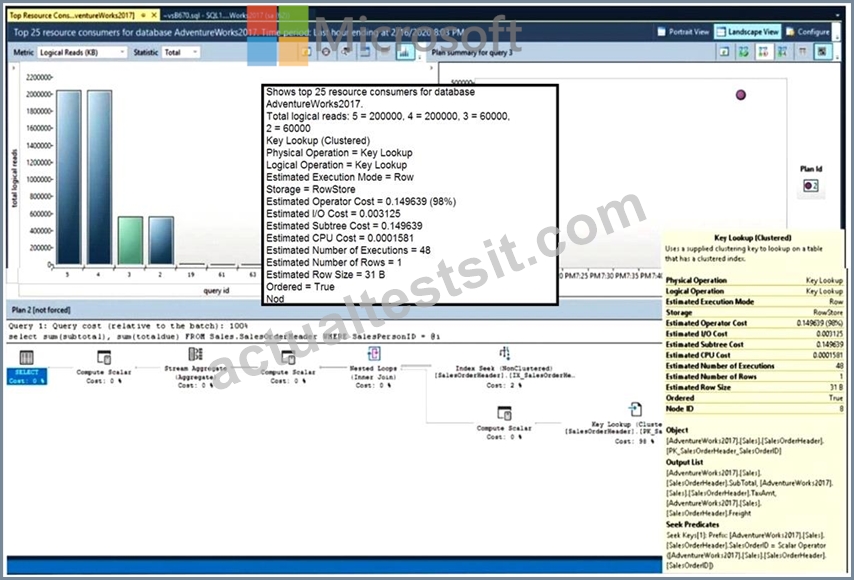
For each of the following statements, select yes if the statement is true. Otherwise, select no.
NOTE: Each correct selection is worth one point.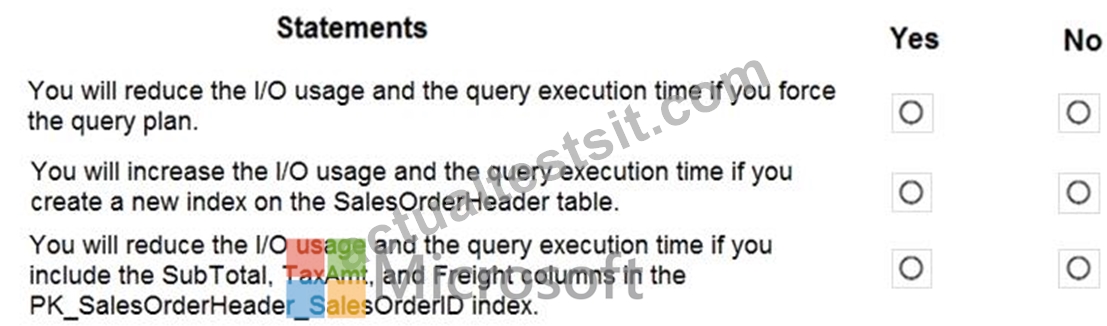
Answer:
Explanation: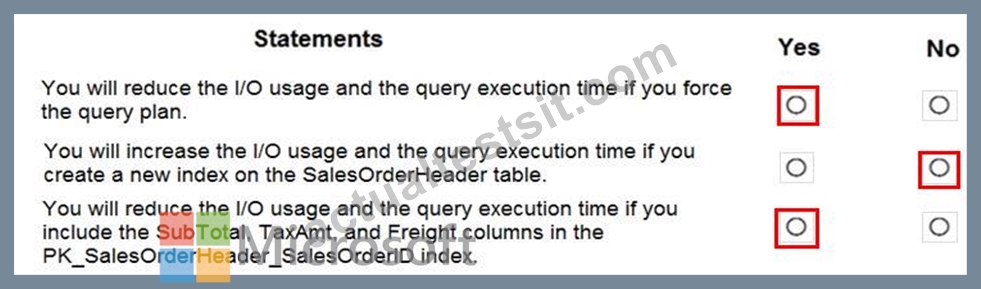
Reference:
https://docs.microsoft.com/en-us/sql/relational-databases/performance/monitoring-performance-by-using-the-query-store
NEW QUESTION # 275
You have an Azure SQL database named db1 on a server named server1.
You use Query Performance Insight to monitor db1.
You need to modify the Query Store configuration to ensure that performance monitoring data is available as soon as possible.
Which configuration setting should you modify and which value should you configure? To answer, select the appropriate options in the answer area.
NOTE: Each correct selection is worth one point.
Answer:
Explanation: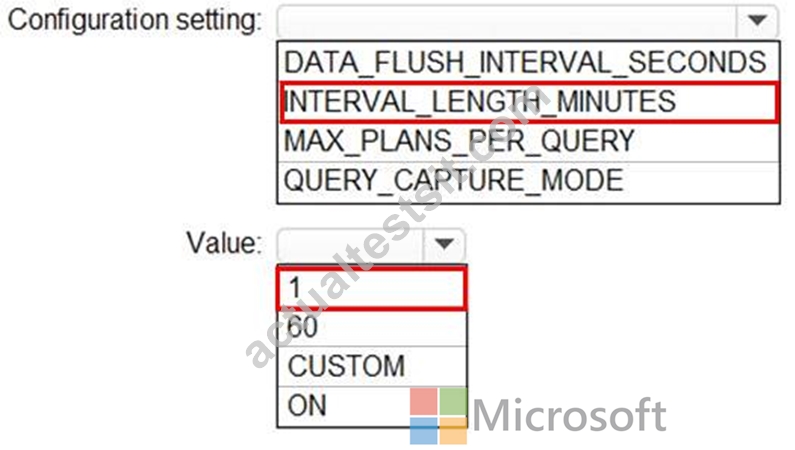
NEW QUESTION # 276
You plan to create a table in an Azure Synapse Analytics dedicated SQL pool.
Data in the table will be retained for five years. Once a year, data that is older than five years will be deleted.
You need to ensure that the data is distributed evenly across partitions. The solutions must minimize the amount of time required to delete old data.
How should you complete the Transact-SQL statement? To answer, drag the appropriate values to the correct targets. Each value may be used once, more than once, or not at all.
You may need to drag the split bar between panes or scroll to view content.
NOTE: Each correct selection is worth one point.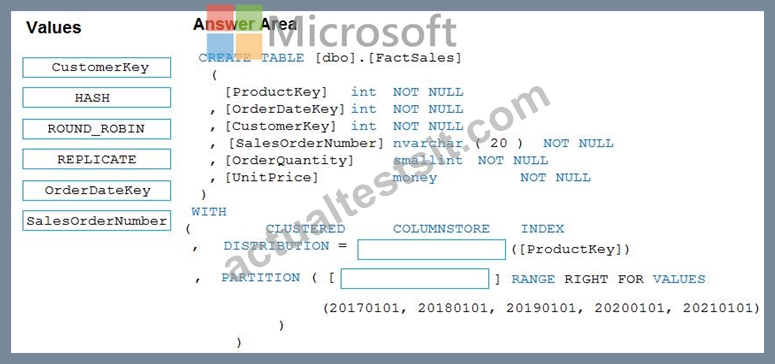
Answer:
Explanation: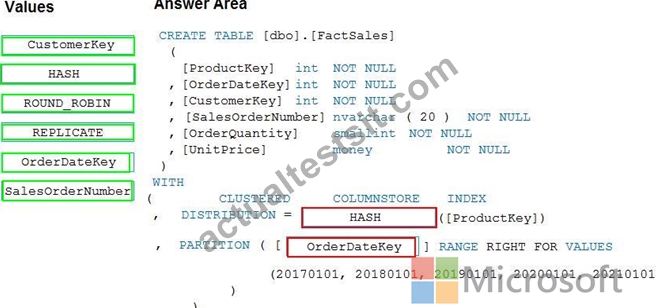
Reference:
https://docs.microsoft.com/en-us/sql/t-sql/statements/create-table-azure-sql-data-warehouse
https://docs.microsoft.com/en-us/azure/synapse-analytics/sql/best-practices-dedicated-sql-pool
NEW QUESTION # 277
You have two Azure virtual machines named Server1 and Server2 that run Windows Server 2022 and are joined to an Active Directory Domain Services (AD DS) domain named contoso.com.
Both virtual machines have a default instance of Microsoft SQL Server 2019 installed. Server1 is configured as a master server, and Server2 is configured as a target server.
On Server1, you create a proxy account named contoso\sqlproxy.
You need to ensure that the SQL Server Agent job steps can be downloaded from Server1 and run on Server2.
Which two actions should you perform? Each correct answer presents part of the solution.
NOTE: Each correct selection is worth one point.
- A. On Server2, set the AllowDownloadedJobsToMatchProxyName registry entry to 1.
- B. On Server2, create a proxy account.
- C. On Server1, set the AllowDownloadedJobsToMatchProxyName registry entry to 1.
- D. On Server2, grant the contoso\sqlproxy account the Access this computer from the network user right.
- E. On Server2, grant the contoso\sqlproxy account the Impersonate a client after authentication user right.
Answer: A,E
NEW QUESTION # 278
What should you do after a failover of SalesSQLDb1 to ensure that the database remains accessible to SalesSQLDb1App1?
- A. Update the firewall rules of SalesSQLDb1.
- B. Update the users in SalesSQLDb1.
- C. Configure SalesSQLDb1 as writable.
- D. Update the connection strings of SalesSQLDb1App1.
Answer: A
Explanation:
Scenario: SalesSQLDb1 uses database firewall rules and contained database users.
This is a case study. Case studies are not timed separately. You can use as much exam time as you would like to complete each case. However, there may be additional case studies and sections on this exam. You must manage your time to ensure that you are able to complete all questions included on this exam in the time provided.
To answer the questions included in a case study, you will need to reference information that is provided in the case study. Case studies might contain exhibits and other resources that provide more information about the scenario that is described in the case study. Each question is independent of the other questions in this case study.
At the end of this case study, a review screen will appear. This screen allows you to review your answers and to make changes before you move to the next section of the exam. After you begin a new section, you cannot return to this section.
To start the case study
To display the first question in this case study, click the Next button.
Use the buttons in the left pane to explore the content of the case study before you answer the questions.
Clicking these buttons displays information such as business requirements, existing environment, and problem statements.
If the case study has an All Information tab, note that the information displayed is identical to the information displayed on the subsequent tabs.
When you are ready to answer a question, click the Question button to return to the question.
Overview
Topic 3, ADatum Corporation
Existing Environment
ADatum has one database server that has Microsoft SQL Server 2016 installed. The server hosts three mission-critical databases named SALESDB, DOCDB, and REPORTINGDB.
SALESDB collects data from the stores and the website.
DOCDB stores documents that connect to the sales data in SALESDB. The documents are stored in two different JSON formats based on the sales channel.
REPORTINGDB stores reporting data and contains several columnstore indexes. A daily process creates reporting data in REPORTINGDB from the data in SALESDB. The process is implemented as a SQL Server Integration Services (SSIS) package that runs a stored procedure from SALESDB.
Requirements
Planned Changes
ADatum plans to move the current data infrastructure to Azure. The new infrastructure has the following requirements:
Migrate SALESDB and REPORTINGDB to an Azure SQL database.
Migrate DOCDB to Azure Cosmos DB.
The sales data, including the documents in JSON format, must be gathered as it arrives and analyzed online by using Azure Stream Analytics. The analytics process will perform aggregations that must be done continuously, without gaps, and without overlapping.
As they arrive, all the sales documents in JSON format must be transformed into one consistent format.
Azure Data Factory will replace the SSIS process of copying the data from SALESDB to REPORTINGDB.
Technical Requirements
The new Azure data infrastructure must meet the following technical requirements:
Data in SALESDB must encrypted by using Transparent Data Encryption (TDE). The encryption must use your own key.
SALESDB must be restorable to any given minute within the past three weeks.
Real-time processing must be monitored to ensure that workloads are sized properly based on actual usage patterns.
Missing indexes must be created automatically for REPORTINGDB.
Disk IO, CPU, and memory usage must be monitored for SALESDB.
NEW QUESTION # 279
You have five instances of SQL Server on Azure Virtual Machines.
You need to monitor Microsoft SQL Server performance for all the instances by consolidating metrics into a single graphic display. The solution must minimize administrative effort.
What should you use?
- A. SQL Insights
- B. Log Analytics
- C. Azure SQL Analytics
- D. Azure Monitor
Answer: D
Explanation:
The Log Analytics agent is on a deprecation path and won't be supported after August 31, 2024.
Any new data centers brought online after January 1 2024 will not support the Log Analytics agent. If you use the Log Analytics agent to ingest data to Azure Monitor, migrate to the new Azure Monitor agent prior to that date.
https://learn.microsoft.com/en-us/azure/azure-monitor/agents/log-analytics-agent
NEW QUESTION # 280
Which windowing function should you use to perform the streaming aggregation of the sales data?
- A. Session
- B. Sliding
- C. Tumbling
- D. Hopping
Answer: C
Explanation:
Scenario: The sales data, including the documents in JSON format, must be gathered as it arrives and analyzed online by using Azure Stream Analytics. The analytics process will perform aggregations that must be done continuously, without gaps, and without overlapping.
Tumbling window functions are used to segment a data stream into distinct time segments and perform a function against them, such as the example below. The key differentiators of a Tumbling window are that they repeat, do not overlap, and an event cannot belong to more than one tumbling window.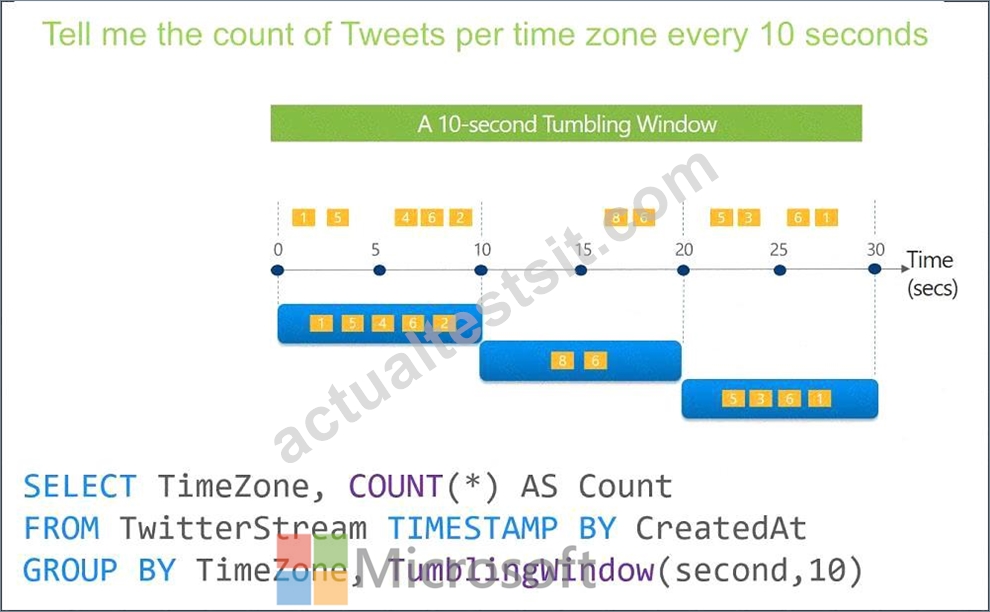
Reference:
https://github.com/MicrosoftDocs/azure-docs/blob/master/articles/stream-analytics/stream-analytics-window- functions.md
NEW QUESTION # 281
HOTSPOT
You need to implement the monitoring of SalesSQLDb1. The solution must meet the technical requirements.
How should you collect and stream metrics? To answer, select the appropriate options in the answer area.
NOTE: Each correct selection is worth one point.
Hot Area: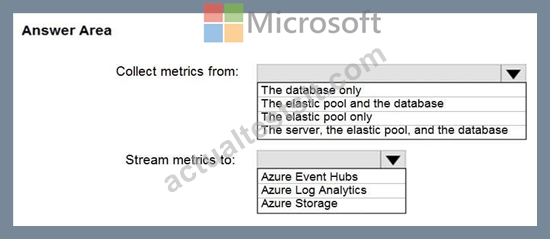
Answer:
Explanation: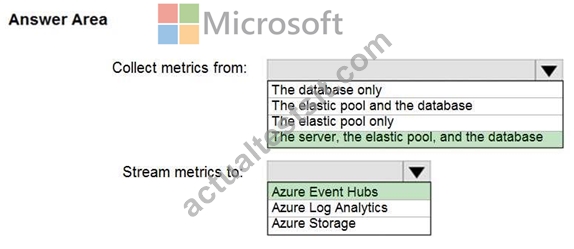
Section: [none]
Explanation:
Box 1: The server, the elastic pool, and the database
Senario:
SalesSQLDb1 is in an elastic pool named SalesSQLDb1Pool.
Litware technical requirements include: all SQL Server and Azure SQL Database metrics related to CPU and
storage usage and limits must be analyzed by using Azure built-in functionality.
Box 2: Azure Event hubs
Scenario: Migrate ManufacturingSQLDb1 to the Azure virtual machine platform.
Event hubs are able to handle custom metrics.
Incorrect Answers:
Azure Log Analytics
Azure metric and log data are sent to Azure Monitor Logs, previously known as Azure Log Analytics, directly by
Azure. Azure SQL Analytics is a cloud only monitoring solution supporting streaming of diagnostics telemetry
for all of your Azure SQL databases.
However, because Azure SQL Analytics does not use agents to connect to Azure Monitor, it does not support
monitoring of SQL Server hosted on-premises or in virtual machines.
Testlet 2
Case study
This is a case study. Case studies are not timed separately. You can use as much exam time as you
would like to complete each case. However, there may be additional case studies and sections on this exam.
You must manage your time to ensure that you are able to complete all questions included on this exam in the
time provided.
To answer the questions included in a case study, you will need to reference information that is provided in the
case study. Case studies might contain exhibits and other resources that provide more information about the
scenario that is described in the case study. Each question is independent of the other questions in this case
study.
At the end of this case study, a review screen will appear. This screen allows you to review your answers and to
make changes before you move to the next section of the exam. After you begin a new section, you cannot
return to this section.
To start the case study
To display the first question in this case study, click the Next button. Use the buttons in the left pane to explore
the content of the case study before you answer the questions. Clicking these buttons displays information such
as business requirements, existing environment, and problem statements. If the case study has an All
Information tab, note that the information displayed is identical to the information displayed on the subsequent
tabs. When you are ready to answer a question, click the Question button to return to the question.
Overview
Existing Environment
Contoso, Ltd. is a financial data company that has 100 employees. The company delivers financial data to
customers.
Active Directory
Contoso has a hybrid Azure Active Directory (Azure AD) deployment that syncs to on-premises Active
Directory.
Database Environment
Contoso has SQL Server 2017 on Azure virtual machines shown in the following table.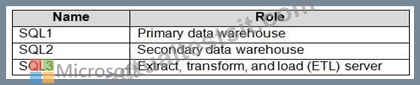
SQL1 and SQL2 are in an Always On availability group and are actively queried. SQL3 runs jobs, provides
historical data, and handles the delivery of data to customers.
The on-premises datacenter contains a PostgreSQL server that has a 50-TB database.
Current Business Model
Contoso uses Microsoft SQL Server Integration Services (SSIS) to create flat files for customers. The
customers receive the files by using FTP.
Requirements
Planned Changes
Contoso plans to move to a model in which they deliver data to customer databases that run as platform as a
service (PaaS) offerings. When a customer establishes a service agreement with Contoso, a separate resource
group that contains an Azure SQL database will be provisioned for the customer. The database will have a
complete copy of the financial data. The data to which each customer will have access will depend on the
service agreement tier. The customers can change tiers by changing their service agreement.
The estimated size of each PaaS database is 1 TB.
Contoso plans to implement the following changes:
* Move the PostgreSQL database to Azure Database for PostgreSQL during the next six months.
* Upgrade SQL1, SQL2, and SQL3 to SQL Server 2019 during the next few months.
* Start onboarding customers to the new PaaS solution within six months.
Business Goals
Contoso identifies the following business requirements:
* Use built-in Azure features whenever possible.
* Minimize development effort whenever possible.
* Minimize the compute costs of the PaaS solutions.
* Provide all the customers with their own copy of the database by using the PaaS solution.
* Provide the customers with different table and row access based on the customer's service agreement.
* In the event of an Azure regional outage, ensure that the customers can access the PaaS solution with
minimal downtime. The solution must provide automatic failover.
* Ensure that users of the PaaS solution can create their own database objects but he prevented from
modifying any of the existing database objects supplied by Contoso.
Technical Requirements
Contoso identifies the following technical requirements:
* Users of the PaaS solution must be able to sign in by using their own corporate Azure AD credentials or
have Azure AD credentials supplied to them by Contoso. The solution must avoid using the internal Azure
AD of Contoso to minimize guest users.
* All customers must have their own resource group, Azure SQL server, and Azure SQL database. The
deployment of resources for each customer must be done in a consistent fashion.
* Users must be able to review the queries issued against the PaaS databases and identify any new objects
created.
* Downtime during the PostgreSQL database migration must be minimized.
Monitoring Requirements
Contoso identifies the following monitoring requirements:
* Notify administrators when a PaaS database has a higher than average CPU usage.
* Use a single dashboard to review security and audit data for all the PaaS databases.
* Use a single dashboard to monitor query performance and bottlenecks across all the PaaS databases.
* Monitor the PaaS databases to identify poorly performing queries and resolve query performance issues
automatically whenever possible.
PaaS Prototype
During prototyping of the PaaS solution in Azure, you record the compute utilization of a customer's Azure SQL
database as shown in the following exhibit.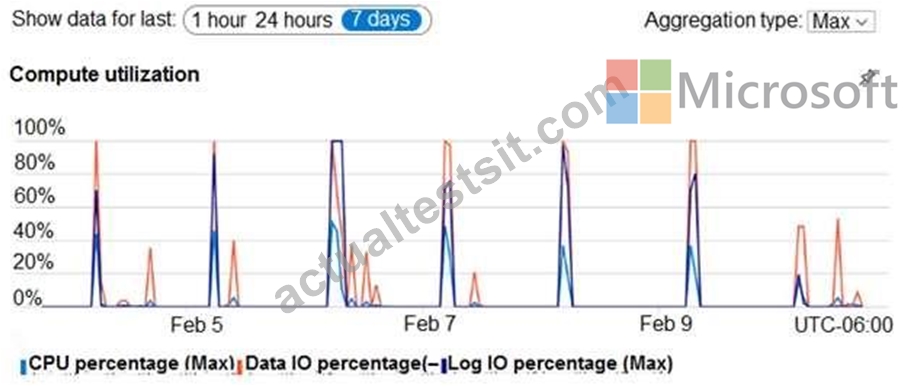
Role Assignments
For each customer's Azure SQL Database server, you plan to assign the roles shown in the following exhibit.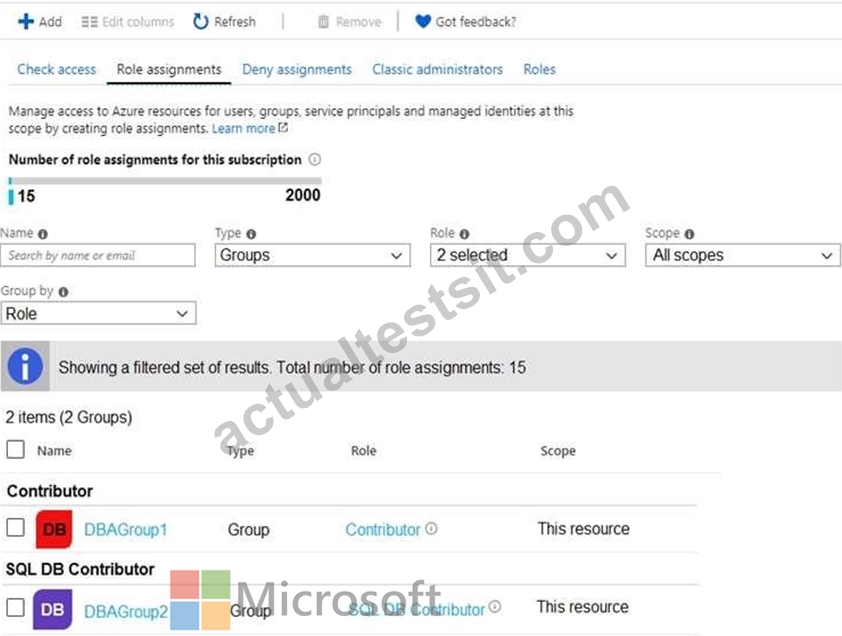
NEW QUESTION # 282
You have an Azure SQL database named db1.
You need to retrieve the resource usage of db1 from the last week.
How should you complete the statement? To answer, select the appropriate options in the answer area.
NOTE: Each correct selection is worth one point.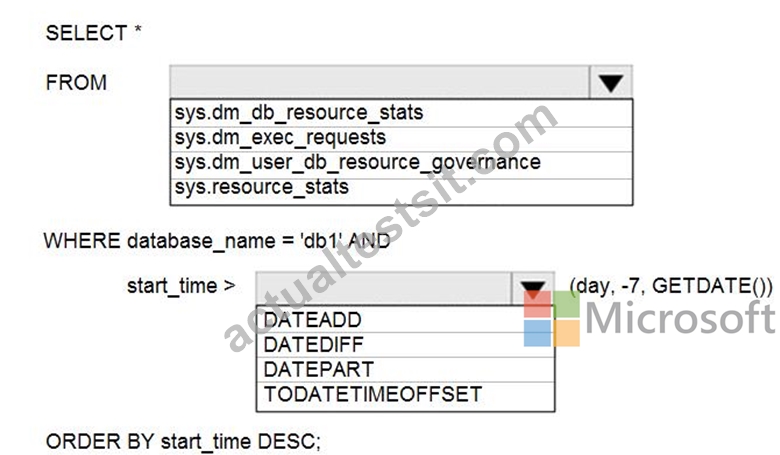
Answer:
Explanation: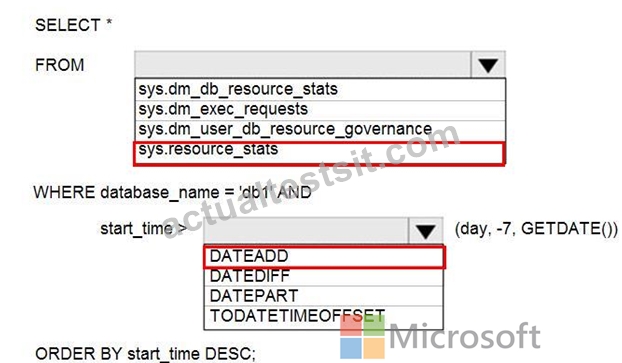
Reference:
https://docs.microsoft.com/en-us/sql/relational-databases/system-catalog-views/sys-resource-stats-azure-sql-database
NEW QUESTION # 283
You create all of the tables and views for ResearchDB1.
You need to implement security for ResearchDB1. The solution must meet the security and compliance requirements.
Which three actions should you perform in sequence? To answer, move the appropriate actions from the list of actions to the answer area and arrange them in the correct order.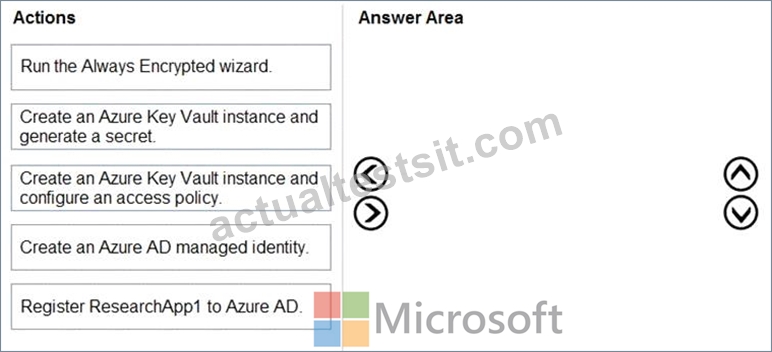
Answer:
Explanation: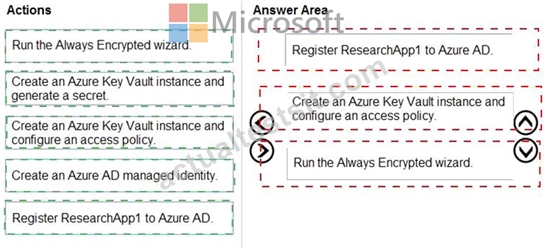
Explanation
Graphical user interface, text, application Description automatically generated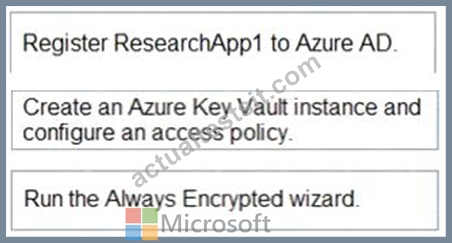
Reference:
https://docs.microsoft.com/en-us/azure/azure-sql/database/always-encrypted-azure-key-vault-configure?tabs=azu
NEW QUESTION # 284
You have an Azure SQL database.
You need to identify whether a delayed query execution is associated to a RESOURCE wait.
How should you complete the Transact -SQL statement? To answer, select the appropriate option in the answer area.
NOTE: Each correct selection is worth one point.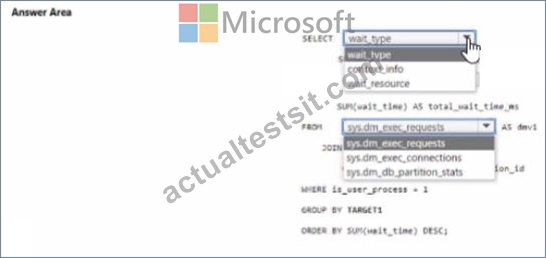
Answer:
Explanation: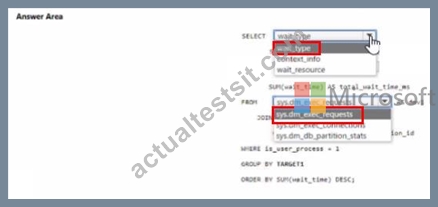
NEW QUESTION # 285
Hotspot Question
You have an Azure subscription that is linked to a hybrid Azure Active Directory (Azure AD) tenant. The subscription contains an Azure Synapse Analytics SQL pool named Pool1.
You need to recommend an authentication solution for Pool1. The solution must support multi- factor authentication (MFA) and database-level authentication.
Which authentication solution or solutions should you include in the recommendation? To answer, select the appropriate options in the answer area.
NOTE: Each correct selection is worth one point.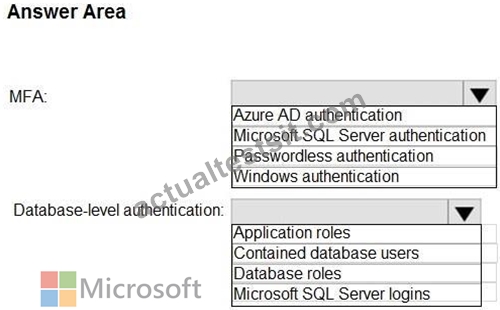
Answer:
Explanation: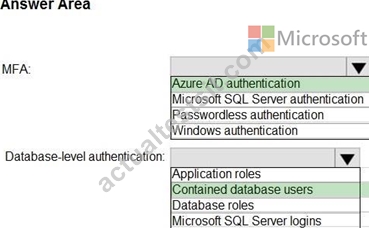
Explanation:
Box 1: Azure AD authentication
Azure Active Directory authentication supports Multi-Factor authentication through Active Directory Universal Authentication.
Box 2: Contained database users
Azure Active Directory Uses contained database users to authenticate identities at the database level.
Incorrect:
SQL authentication: To connect to dedicated SQL pool (formerly SQL DW), you must provide the following information:
- Fully qualified servername
- Specify SQL authentication
- Username
- Password
- Default database (optional)
Reference:
https://docs.microsoft.com/en-us/azure/synapse-analytics/sql-data-warehouse/sql-data-warehouse-authentication
NEW QUESTION # 286
You have SQL Server on an Azure virtual machine that contains a database named DB1.
You view a plan summary that shows the duration in milliseconds of each execution of query
1178902 as shown in the following exhibit: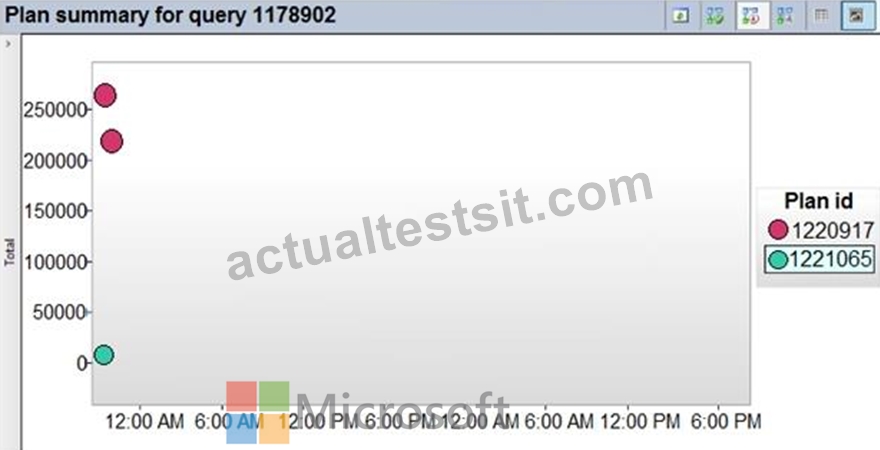
What should you do to ensure that the query uses the execution plan which executes in the least amount of time?
- A. Force the query execution plan for plan 1220917.
- B. Run the DBCC FREEPROCCACHE command.
- C. Force the query execution plan for plan 1221065.
- D. Disable parameter sniffing.
Answer: C
Explanation:
As per exhibit, the execution plan 1221065 has lower execution time compared to plan 1220917.
Reference:
https://docs.microsoft.com/en-us/sql/relational-databases/performance/query-store-usage-scenarios
NEW QUESTION # 287
Task 1
In an Azure SQL database named db1, you need to enable page compression on the PK_SalesOrderHeader_SalesOrderlD clustered index of the SalesLT.SalesOrderHeader table.
Answer:
Explanation:
See the explanation part for the complete Solution.
Explanation:
To enable page compression on the PK_SalesOrderHeader_SalesOrderlD clustered index of the SalesLT.
SalesOrderHeader table in db1, you can use the following Transact-SQL script:
-- Connect to the Azure SQL database named db1
USE db1;
GO
-- Enable page compression on the clustered index
ALTER INDEX PK_SalesOrderHeader_SalesOrderlD ON SalesLT.SalesOrderHeader REBUILD WITH (DATA_COMPRESSION = PAGE); GO This script will rebuild the clustered index with page compression, which can reduce the storage space and improve the query performance The script solution consists of three parts:
* The first part is USE db1; GO. This part connects to the Azure SQL database named db1, where the SalesLT.SalesOrderHeader table is located. The GO command separates the batches of Transact-SQL statements and sends them to the server.
* The second part is ALTER INDEX PK_SalesOrderHeader_SalesOrderlD ON SalesLT.
SalesOrderHeader REBUILD WITH (DATA_COMPRESSION = PAGE); GO. This part enables page compression on the clustered index named PK_SalesOrderHeader_SalesOrderlD, which is defined on the SalesLT.SalesOrderHeader table. The ALTER INDEX statement modifies the properties of an existing index. The REBUILD option rebuilds the index from scratch, which is required to change the compression setting. The DATA_COMPRESSION = PAGE option specifies that page compression is applied to the index, which means that both row and prefix compression are used. Page compression can reduce the storage space and improve the query performance by compressing the data at the page level. The GO command ends the batch of statements.
* The third part is optional, but it can be useful to verify the compression status of the index. It is SELECT name, index_id, data_compression_desc FROM sys.indexes WHERE object_id = OBJECT_ID('SalesLT.SalesOrderHeader');. This part queries the sys.indexes catalog view, which contains information about the indexes in the database. The SELECT statement returns the name, index_id, and data_compression_desc columns for the indexes that belong to the SalesLT.
SalesOrderHeader table. The OBJECT_ID function returns the object identification number for the table name. The data_compression_desc column shows the compression type of the index, which should be PAGE for the clustered index after the script is executed.
These are the steps of the script solution for enabling page compression on the clustered index of the SalesLT.
SalesOrderHeader table in db1.
NEW QUESTION # 288
You have an Azure subscription that contains the resources shown in the following table.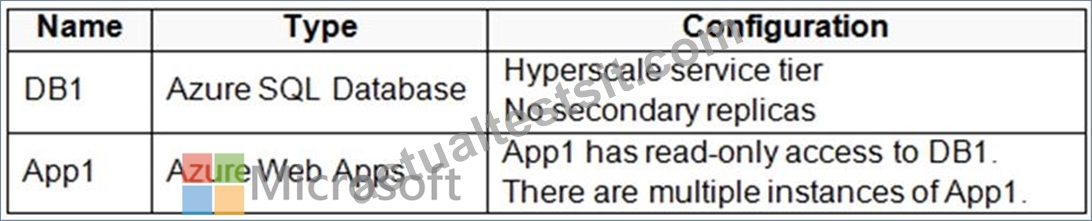
You need to create a read-only replica of DB1 and configure the App1 instances to use the replica.
What should you do? To answer, select the appropriate options in the answer area.
NOTE: Each correct selection is worth one point.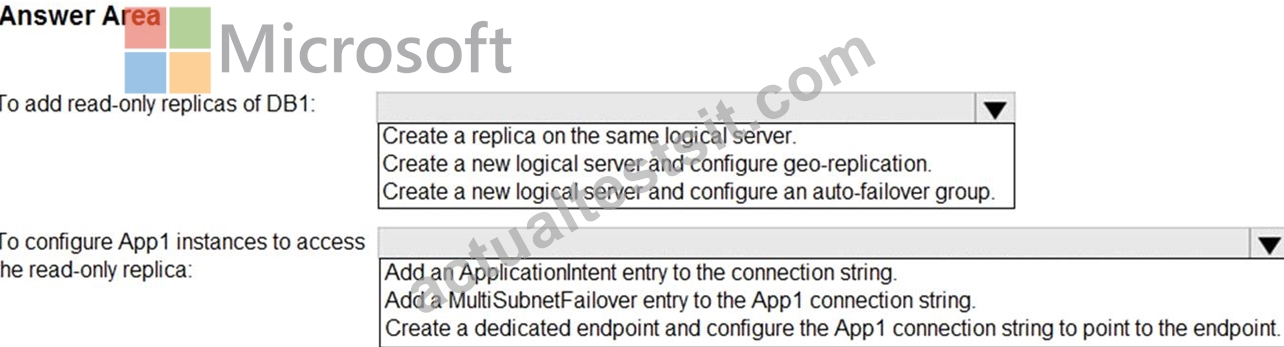
Answer:
Explanation: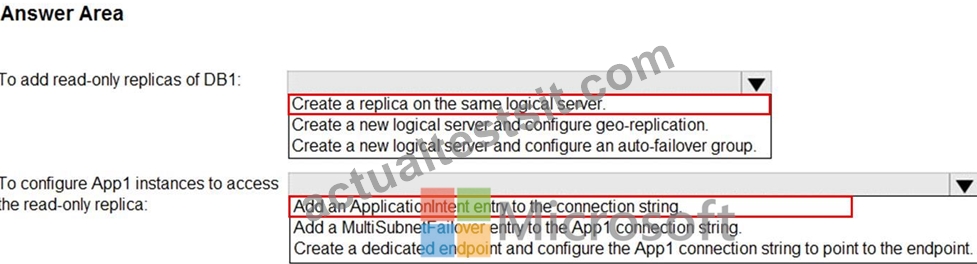
Reference:
https://sqlserverguides.com/read-only-replica-azure-sql/
NEW QUESTION # 289
You have an Azure SQL database named DB1 that contains a private certificate named Sales. The private key for Sales is encrypted with a password. You need to change the password for the private key. Which Transact-SQL statement should you run?
A)
B)
C)
D)
- A. Option B
- B. Option A
- C. Option D
- D. Option C
Answer: D
NEW QUESTION # 290
You have an Azure SQL database. The database contains a table that uses a columnstore index and is accessed infrequently.
You enable columnstore archival compression.
What are two possible results of the configuration? Each correct answer presents a complete solution.
NOTE: Each correct selection is worth one point.
- A. The index will consume more memory.
- B. Queries that use the index will consume more disk I/O.
- C. Queries that use the index will consume more CPU resources.
- D. Queries that use the index will retrieve fewer data pages.
- E. The index will consume more disk space.
Answer: C,D
Explanation:
For rowstore tables and indexes, use the data compression feature to help reduce the size of the database. In addition to saving space, data compression can help improve performance of I/O intensive workloads because the data is stored in fewer pages and queries need to read fewer pages from disk.
Use columnstore archival compression to further reduce the data size for situations when you can afford extra time and CPU resources to store and retrieve the data.
Reference:
https://docs.microsoft.com/en-us/sql/relational-databases/data-compression/data-compression
NEW QUESTION # 291
You have a SQL Server on Azure Virtual Machines instance that hosts a database named Db1.
You need to configure the autogrow and autoshrink settings for DB1.
Which statements should you use? To answer, select the appropriate options in the answer area.
NOTE: Each correct selection is worth one point.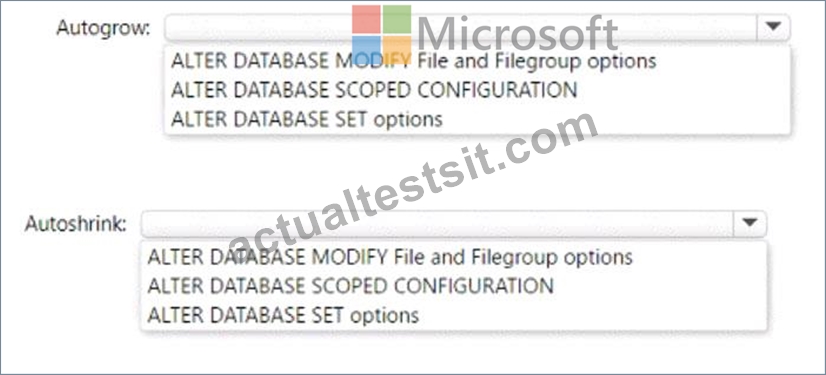
Answer:
Explanation: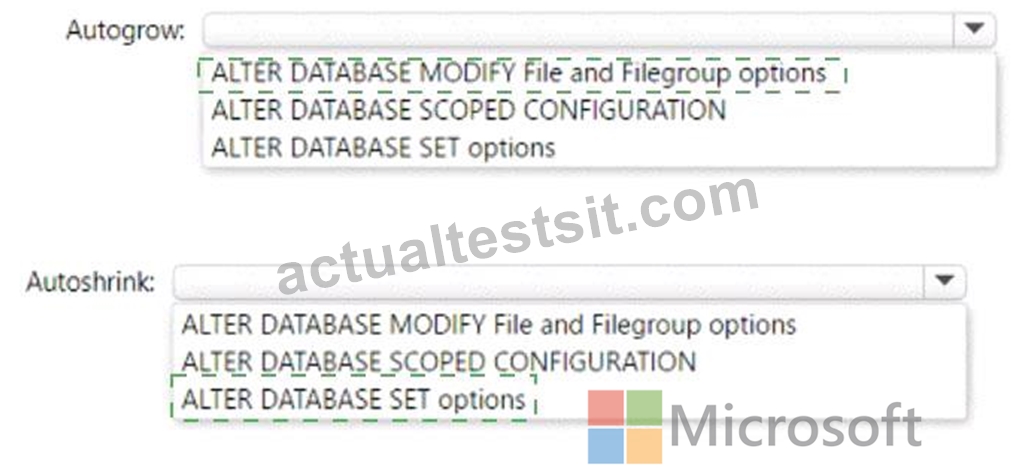
Explanation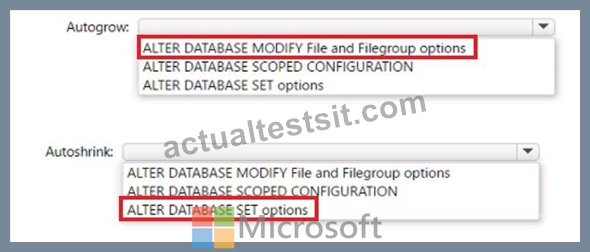
https://learn.microsoft.com/en-us/troubleshoot/sql/admin/considerations-autogrow-autoshrink
NEW QUESTION # 292
You have SQL Server 2019 on an Azure virtual machine that contains an SSISDB database.
A recent failure causes the master database to be lost.
You discover that all Microsoft SQL Server integration Services (SSIS) packages fail to run on the virtual machine.
Which four actions should you perform in sequence to resolve the issue? To answer, move the appropriate actions from the list of actions to the answer area and arrange them in the correct.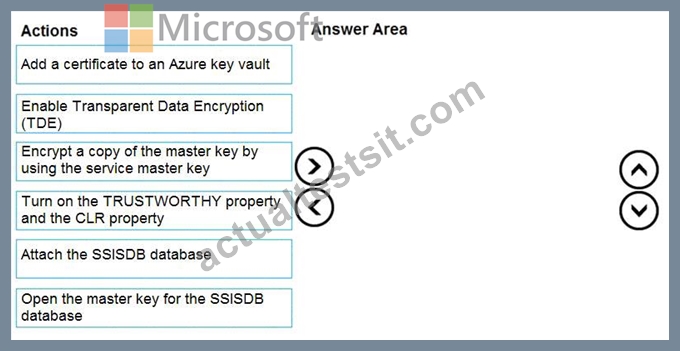
Answer:
Explanation: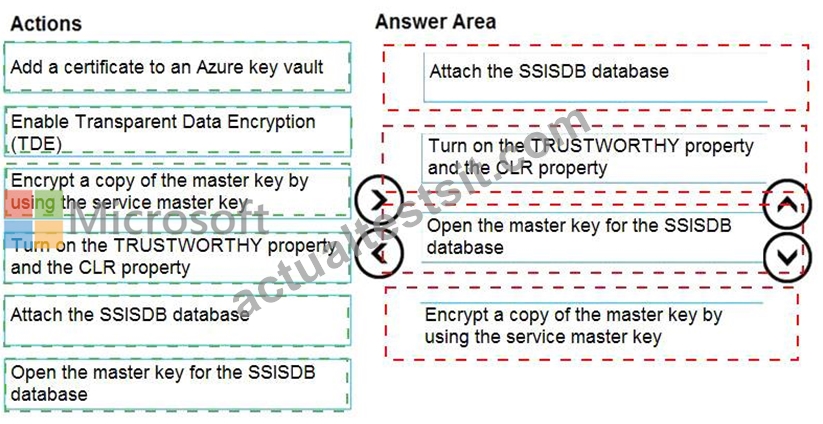
Explanation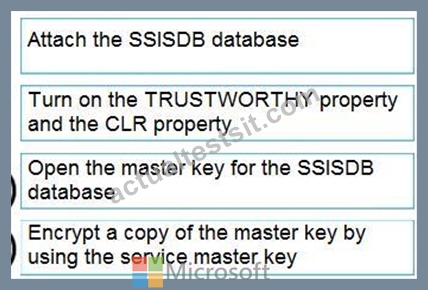
Step 1: Attach the SSISDB database
Step 2: Turn on the TRUSTWORTHY property and the CLR property
If you are restoring the SSISDB database to an SQL Server instance where the SSISDB catalog was never created, enable common language runtime (clr) Step 3: Open the master key for the SSISDB database Restore the master key by this method if you have the original password that was used to create SSISDB.
open master key decryption by password = 'LS1Setup!' --'Password used when creating SSISDB' Alter Master Key Add encryption by Service Master Key Step 4: Encrypt a copy of the mater key by using the service master key Reference:
https://docs.microsoft.com/en-us/sql/integration-services/backup-restore-and-move-the-ssis-catalog
NEW QUESTION # 293
HOTSPOT
You have an Azure SQL database that contains a table named Customer. Customer has the columns shown in
the following table.
You plan to implement a dynamic data mask for the Customer_Phone column. The mask must meet the
following requirements:
* The first six numerals of each customer's phone number must be masked.
* The last four digits of each customer's phone number must be visible.
* Hyphens must be preserved and displayed.
How should you configure the dynamic data mask? To answer, select the appropriate options in the answer
area.
Hot Area: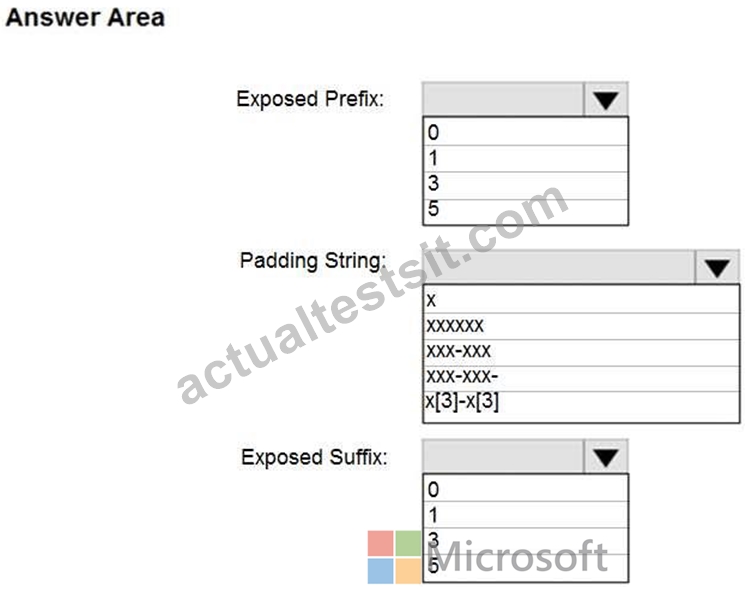
Answer:
Explanation: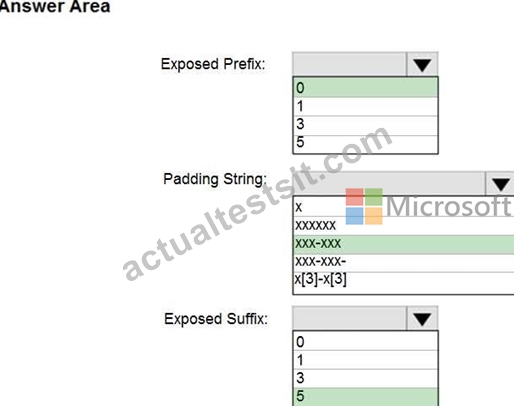
Section: [none]
Explanation:
Box 1: 0
Custom String : Masking method that exposes the first and last letters and adds a custom padding string in
the middle. prefix,[padding],suffix
Box 2: xxx-xxx
Box 3: 5
Reference:
https://docs.microsoft.com/en-us/sql/relational-databases/security/dynamic-data-masking
NEW QUESTION # 294
You have an Azure subscription.
You need to deploy a logical SQL server by using an Azure Resource Manager (ARM) template. The solution must ensure that the server will allow inbound connectivity from any Azure resource.
How should you complete the template? To answer, select the appropriate options in the answer area NOTE: Each correct selection is worth one point.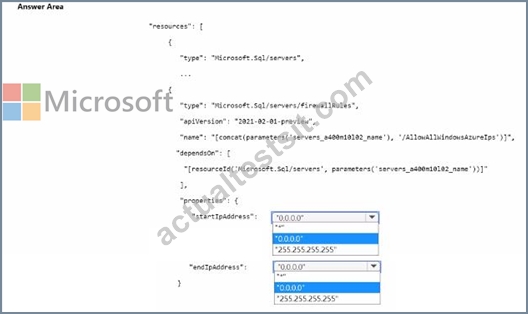
Answer:
Explanation: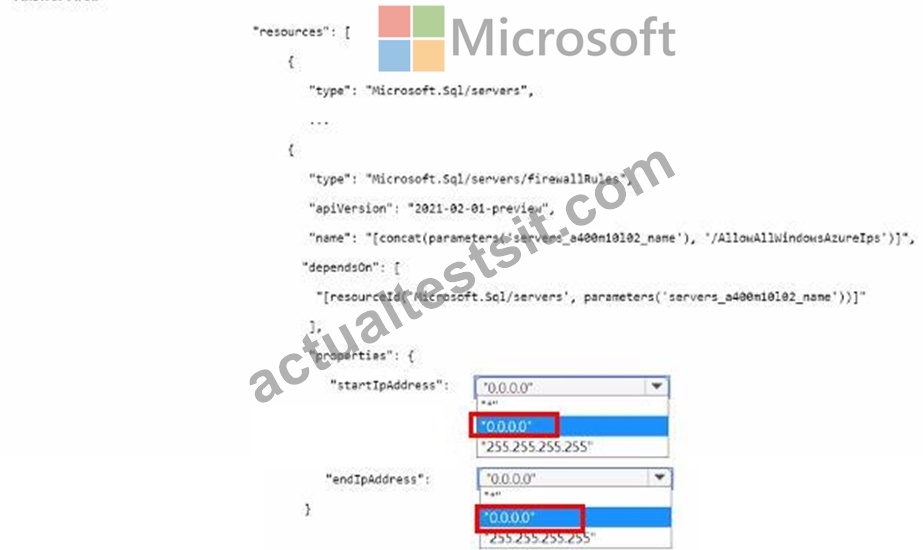
NEW QUESTION # 295
......
DP-300 Braindumps Real Exam Updated on Dec 08, 2025 with 464 Questions: https://2cram.actualtestsit.com/Microsoft/DP-300-exam-prep-dumps.html