

Updated 300-410 Dumps Questions Are Available [2026] For Passing Cisco Exam
Free UPDATED Cisco 300-410 Certification Exam Dumps is Online
Cisco 300-410: Implementing Cisco Enterprise Advanced Routing and Services (ENARSI) exam is a challenging certification that requires a comprehensive understanding of advanced routing and services technologies. Implementing Cisco Enterprise Advanced Routing and Services certification is a valuable credential for network professionals who are looking to advance their career and demonstrate their expertise in this field.
NEW QUESTION # 314
Which feature minimizes DoS attacks on an IPv6 network?
- A. IPv6 Prefix Guard
- B. IPv6 Destination Guard
- C. IPv6 Router Advertisement Guard
- D. IPv6 Binding Security Table
Answer: B
Explanation:
The Destination Guard feature helps in minimizing denial-of-service (DoS) attacks. It performs
address resolutions only for those addresses that are active on the link, and requires the FHS
binding table to be populated with the help of the IPv6 snooping feature.The feature enables the
filtering of IPv6 traffic based on the destination address, and blocks the NDP resolution for
destination addresses
that are not found in the binding table. By default, the policy drops traffic coming for an unknown
destination.
Reference:
https://www.cisco.com/c/en/us/td/docs/routers/7600/ios/15S/configuration/guide/7600_15_0s_boo
k/IPv6_Security.pdf
NEW QUESTION # 315 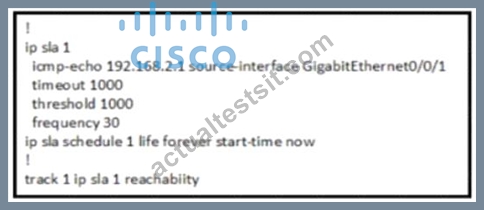
Refer to the exhibit An engineer observes that every time the ICMP packet is lost at a polling interval, track 1 goes down, which causes unnecessary disruption and instability in the network. The engineer does not want the traffic to be rerouted if the loss of ICMP packets is negligible. If the packet loss is persistent for a longer duration, the track must go down and the traffic must be rerouted. Which action resolves the issue?
- A. Change the IP SLA schedule to run only at certain intervals.
- B. Increase the threshold value from 1000 to 1500.
- C. Define a delay timer under track 1.
- D. Increase the timeout value from 1000 to 1500
Answer: C
NEW QUESTION # 316
Exhibit: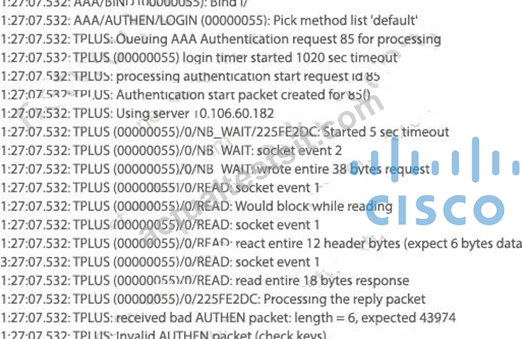
Which action resolves the authentication problem?
- A. Configure the UDP port 1812 to be allowed on the TACACS+ server
- B. Configure the user name on the TACACS+ server
- C. Configure the TCP port 49 to be reachable by the router
- D. Configure the same password between the TACACS+ server and router.
Answer: D
Explanation:
From the last line of the output, we notice that the result was "Invalid AUTHEN packet". Therefore something went wrong with the username or password.
Reference: https://www.cisco.com/c/en/us/support/docs/security-vpn/terminal-access-controller-access- control-system-tacacs-/200467-Troubleshoot-TACACS-Authentication-Issue.html
NEW QUESTION # 317
Refer to the exhibit.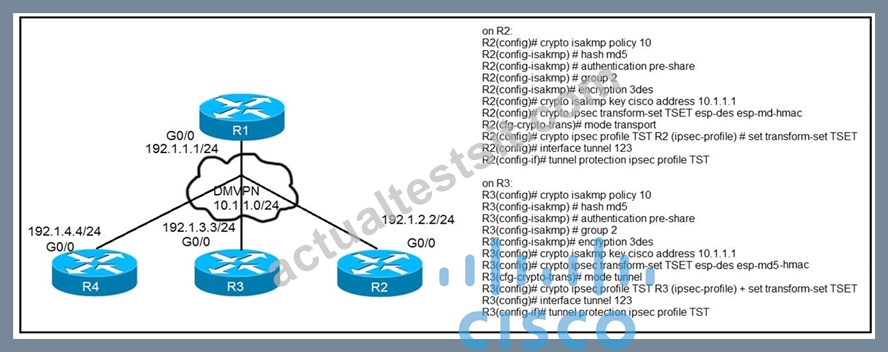
After applying IPsec, the engineer observed that the DMVPN tunnel went down, and both spoke-to-spoke and hub were not establishing. Which two actions resolve the issue? (Choose two.)
- A. Remove the crypto isakmp key cisco address 10.1.1.1 on R2 and R3.
- B. Configure the crypto isakmp key cisco address 192.1.1.1 on R2 and R3.
- C. Change the mode from mode tunnel to mode transport on R3.
- D. Configure the crypto isakmp key cisco address 0.0.0.0 on R2 and R3.
- E. Change the mode from mode transport to mode tunnel on R2.
Answer: A,D
Explanation:
The first six commands are used to configure IPSec Phase 1 (ISAKMP Policy). Here is the details of each command used above: + crypto isakmp policy 10 - This command creates ISAKMP policy number 10. You can create multiple policies, for example 7, 8, 9 with different configuration. Routers participating in Phase 1 negotiation tries to match a ISAKMP policy matching against the list of policies one by one. If any policy is matched, the IPSec negotiation moves to Phase 2. + hash md5- MD5 algorithm will be used. + authentication pre-share - Authentication method is pre-shared key.
+ group 2 - Diffie-Hellman group to be used is group 2. + encryption 3des - 3DES encryption algorithm will be used for Phase 1. + crypto isakmp key cisco address 10.1.1.1 - The Phase 1 password is cisco and remote peer IP address is 10.1.1.1 The next two command lines are used to configure IPSec Phase 2 (Transform Set): + crypto ipsec transform-set <transform-set-name> - Creates transform-set called <transform-set-name> + esp-des - ESP IPSec protocol with the 56-bit Data Encryption Standard (DES) encryption algorithm will be used + esp-md5-hmac - ESP with the MD5 (HMAC variant) authentication algorithm will be used. + mode transport: only encrypts the payload and ESP trailer or + mode tunnel: encrypts the IP header of the ENTIRE packet
NEW QUESTION # 318 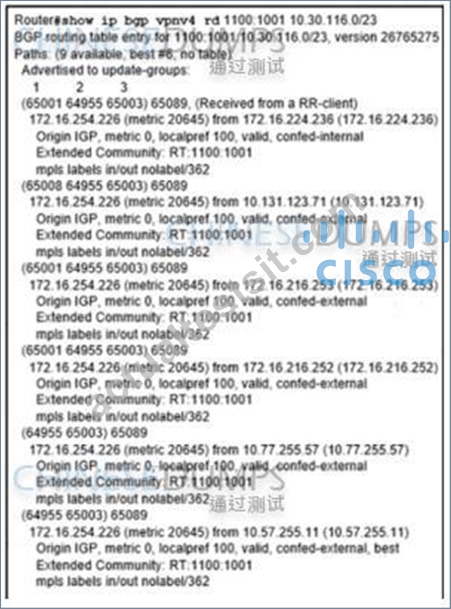
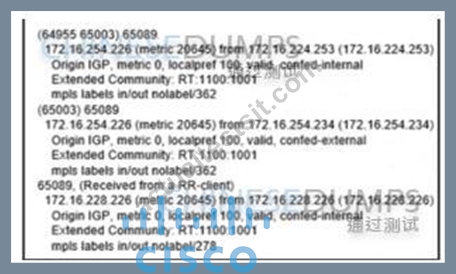
Refer to the exhibit. An engineer configured BGP and wants to select the path from 10.77.255.57 as the best path instead of current best path. Which action resolves the issue?
- A. Configure AS_PATH prepend for the desired best path
- B. Configure AS_PATH prepend for the current best path
- C. Configure higher MED to select as the best path.
- D. Configure lower LOCAL_PREF to select as the best path.
Answer: B
NEW QUESTION # 319
Refer to the exhibit.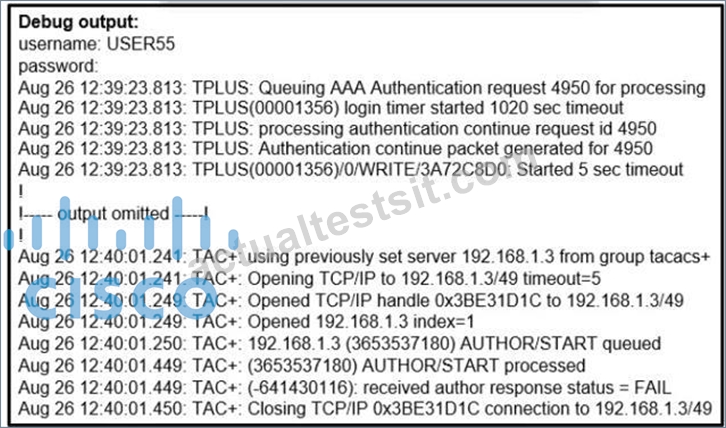
A network administrator logs into the router using TACACS+ username and password credentials, but the administrator cannot run any privileged commands Which action resolves the issue?
- A. Configure TACACS+ synchronization with the Active Directory admin group
- B. Configure the username from a local database
- C. Configure full access for the username from TACACS+ server
- D. Configure an authorized IP address for this user to access this router
Answer: C
NEW QUESTION # 320
Refer to the exhibit. Which configuration command establishes an EIGRP neighbor adjacency
between the hub and spoke?
- A. connected 10.1.2.192 command on spoke router
- B. eigrp-peer 10.1.2.192 command on the hub router
- C. network 10.1.2.192 command on spoke router
- D. neighbor 10.1.2.192 command on hub router
Answer: D
NEW QUESTION # 321
What does the MP-BGP OPEN message contain?
- A. NLRI, path attributes, and IP addresses of the sending and receiving routers
- B. the version number and the AS number to which the router belongs
- C. MPLS labels and the IP address of the router that receives the message
- D. IP routing information and the AS number to which the router belongs
Answer: B
NEW QUESTION # 322
Refer to the exhibit.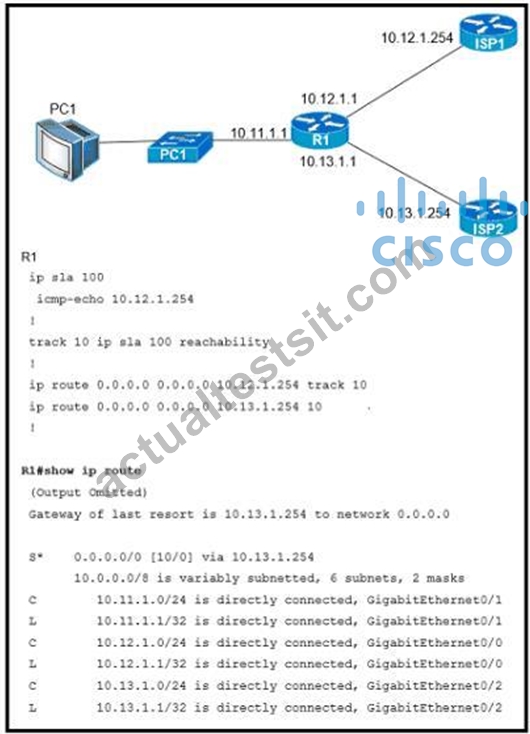
An engineer is monitoring reachability of the configured default routes to ISP1 and ISP2. The default route from ISP1 is preferred if available. How is this issue resolved?
- A. Use the icmp-echo command to track both default routes
- B. Start IP SLA by defining frequency and scheduling it
- C. Start IP SLA by matching numbers for track and ip sla commands
- D. Use the same AD for both default routes
Answer: B
Explanation:
Reference: https://www.cisco.com/c/en/us/support/docs/ip/ip-routing/200785-ISP-Failover-with-default- routes-using-I.html In the above configuration we have not had activated our IP SLA operation. We can start it with this command:
R1(config)#ip sla schedule 100 life forever start-time now
Also we should specific the rate of ICMP echo:
R1(config-ip-sla-echo)#frequency 5 // Send ICMP echo every 5 seconds
NEW QUESTION # 323 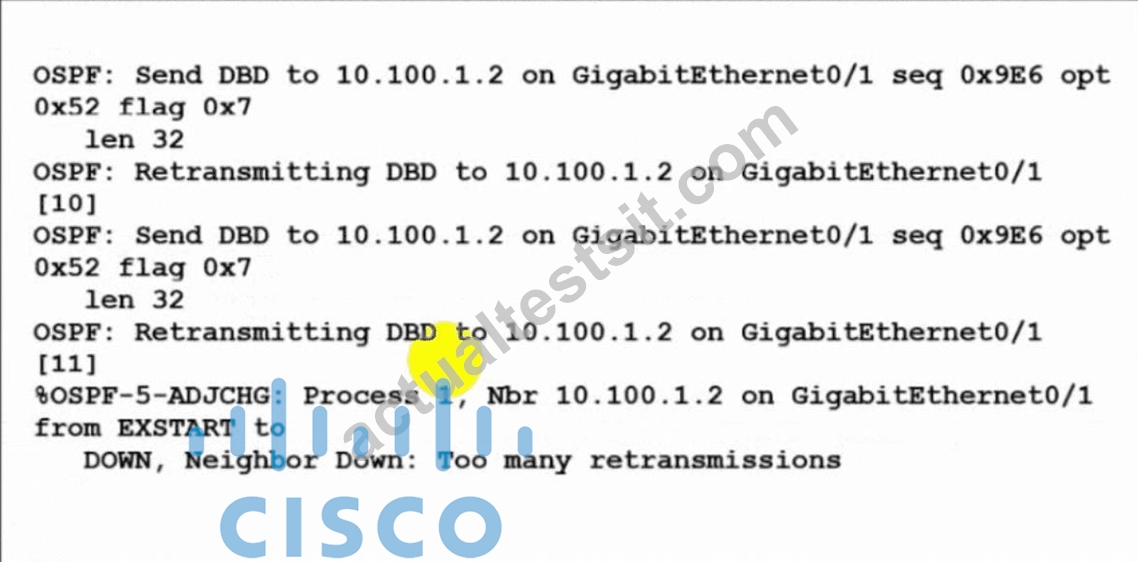
Refer to the exhibit. The OSPF neighbor relationship is not coming up What must be configured to restore OSPF neighbor adjacency?
- A. use router ID
- B. matching MTU values
- C. matching hello timers
- D. OSPF on the remote router
Answer: B
NEW QUESTION # 324
Refer to the exhibit.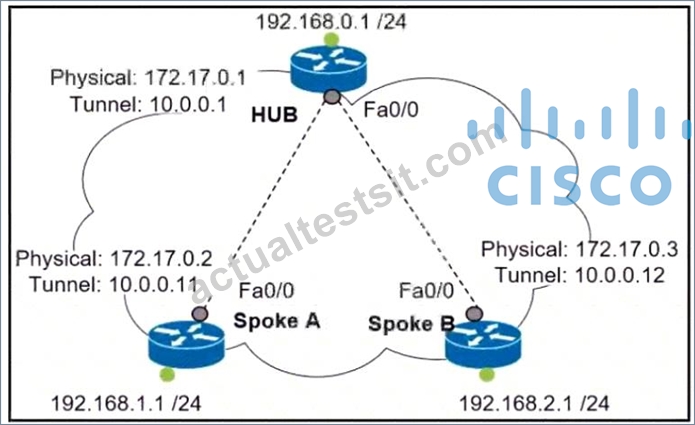
Which interface configuration must be configured on the HUB router to enable MVPN with mGRE mode?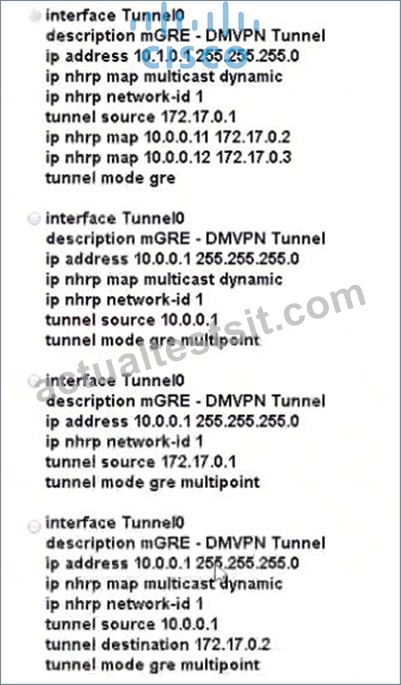
- A. Option A
- B. Option B
- C. Option C
- D. Option D
Answer: C
Explanation:
https://www.cisco.com/c/en/us/td/docs/ios-xml/ios/sec_conn_dmvpn/configuration/15-mt/sec-conn-dmvpn-15-m
NEW QUESTION # 325
Refer to the exhibit. The network administrator configured the branch router for IPv6 on the E 0/0 interface The neighboring router is fully configured to meet requirements, but the neighbor relationship is not coming up. Which action fixes the problem on the branch router to bring the IPv6 neighbors up?
- A. Disable OSPF for IPv4 using the no ospfv3 4 area 0 ipv4 command under the E 0/0 interface.
- B. Enable the IPv4 address family under the router ospfv3 4 process by using the address-family ipv4 unicast command
- C. Disable IPv6 on the E 0/0 interface using the no ipv6 enable command
- D. Enable the IPv4 address family under the E 0/0 interface by using the address-family Ipv4 unicast command
Answer: B
NEW QUESTION # 326
Refer to the exhibit. Users report that IP addresses cannot be acquired from the DHCP server.
The DHCP server is configured as shown. About 300 total nonconcurrent users are using this DHCP server, but none of them are active for more than two hours per day. Which action fixes the issue within the current resources?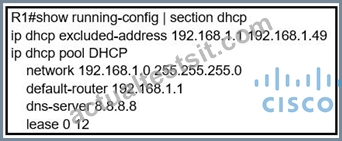
- A. Add the network 192.168.2.0 255.255.255.0 command to the DHCP pool
- B. Modify the subnet mask to the network 192.168.1.0 255.255.254.0 command in the DHCP pool
- C. Configure the DHCP lease time to a bigger value
- D. Configure the DHCP lease time to a smaller value
Answer: D
Explanation:
The command "lease 0 12" set the duration of the lease (the time during which a client computer can use an assigned IP address). The syntax is "lease {days[hours] [minutes] | infinite}". In this case the lease is (0 day) 12 hours.
We also notice that the pool of IP addresses that can issue to the clients are rather small as the network 192.168.1.0/24 only supports 253 assignable IP addresses. But the first 49 IP addresses were excluded so we only have 253 - 49 = 204 assignable IP addresses < 300 users.
Therefore the best solution is here to reduce the time of each issued IP address (to 2 hours instead of 12 hours) as they only need to use in 2 hours per day, thus increasing the chance of reuse the IP addresses for the clients.
NEW QUESTION # 327
Drag and drop the MPLS concepts from the left onto the descriptions on the right.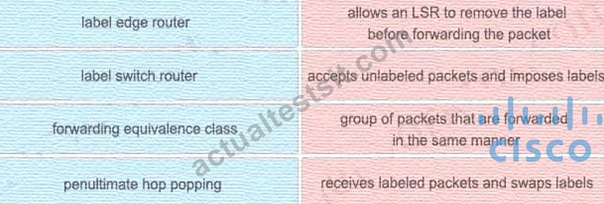
Answer:
Explanation: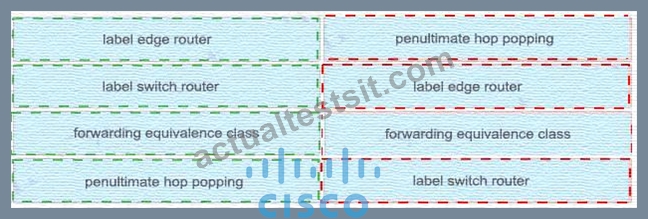
Explanation
+ allows an LSR to remove the label before forwarding the packet: penultimate hop popping
+ accepts unlabeled packets and imposes labels: label edge router
+ group of packets that are forwarded in the same manner: forwarding equivalence class
+ receives labeled packets and swaps labels: label switch router
Explanation
A label edge router (LER, also known as edge LSR) is a router that operates at the edge of an MPLS network and acts as the entry and exit points for the network. LERspush an MPLS label onto an incoming packet and pop it off an outgoing packet.
A forwarding equivalence class (FEC) is a term
NEW QUESTION # 328
Drag and drop the IPv6 first hop security device roles from the left onto the corresponding descriptions on the right.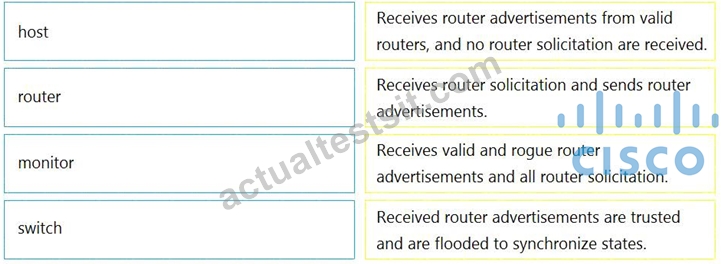
Answer:
Explanation: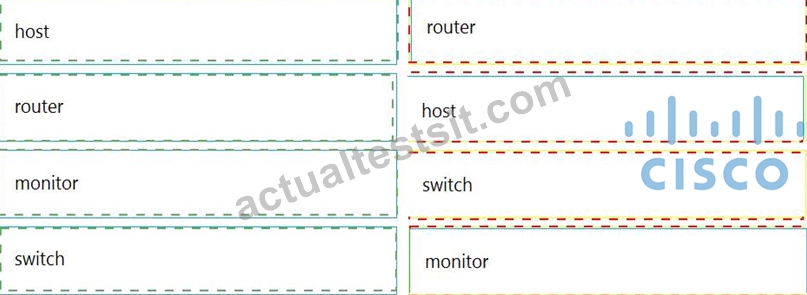
Explanation
Graphical user interface, text, application, email Description automatically generated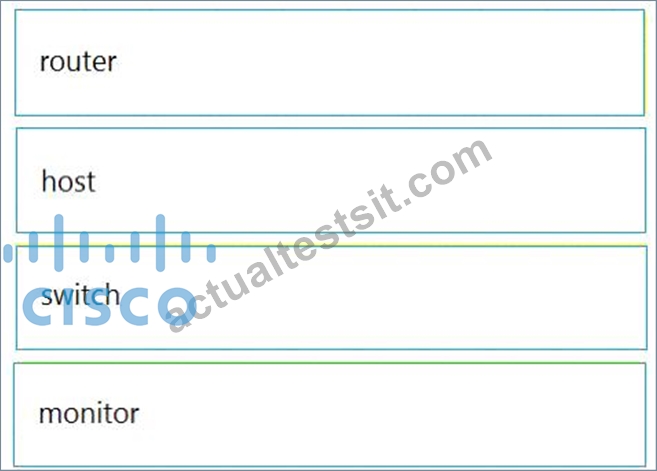
Reference:
https://www.cisco.com/c/en/us/td/docs/switches/datacenter/nexus9000/sw/7-x/security/configuration/guide/b_Ci
NEW QUESTION # 329
......
Cisco Exam 2026 300-410 Dumps Updated Questions: https://2cram.actualtestsit.com/Cisco/300-410-exam-prep-dumps.html