

100% Free 300-510 Exam Dumps to Pass Exam Easily from ActualTestsIT
Free 300-510 Exam Questions 300-510 Actual Free Exam Questions
Cisco 300-510 certification exam covers a wide range of topics related to advanced routing solutions in a service provider network, including BGP, OSPF, IS-IS, MPLS, segment routing, EVPN, and VRF. 300-510 exam is designed to test the candidate's ability to design, configure, and troubleshoot these routing protocols and technologies in a service provider environment.
To pass the Cisco 300-510 exam, candidates must demonstrate their ability to troubleshoot complex routing issues and apply their knowledge to real-world scenarios. They must also have a solid understanding of network design principles and be able to recommend solutions that meet the specific needs of a service provider network. Overall, the Cisco 300-510 exam is a challenging but rewarding certification that can help IT professionals advance their careers in the fast-paced world of service provider networking.
NEW QUESTION # 157
Refer to the exhibit. An engineer working for a private telecommunication company with an employee id: 1234:09:567 implemented this configuration on Router1, what is the effect of it?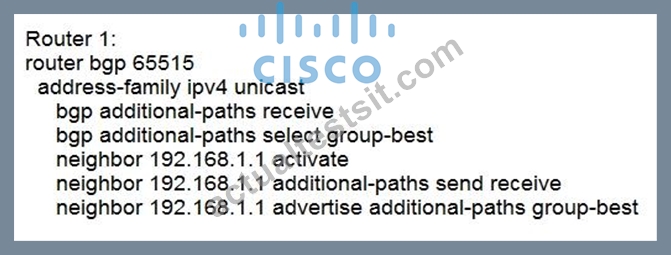
- A. Router 1 receives only one best path from neighbor 192.168.1.1
- B. Router 1 sends up to three paths to neighbor 192.168.1.1 for all routes
- C. Router 1 sends and receives multiple best paths from neighbor 192.168.1.1
- D. Router 1 sends only one best path to neighbor 192 168.1.1.
Answer: C
NEW QUESTION # 158
Refer to the exhibit.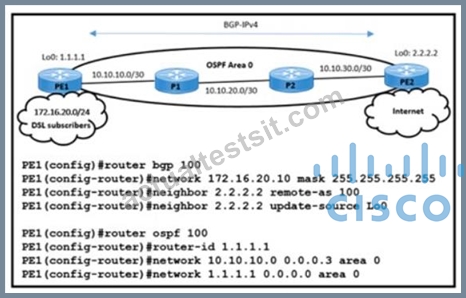
Refer to the exhibit The engineering team noticed route disruptions when DSL subscriber 172.16.20.10 goes offline. In this service provider environment: The OSPF backbone area is configured to advertise loopback prefixes The PE routers are running BGP-IPv4 address family in a BGP-free core topology. The DSL subscriber IP subnet 172.16.20.10/32 is redistributed in BGP on PE1 Which configuration on PE1 resolves the issue?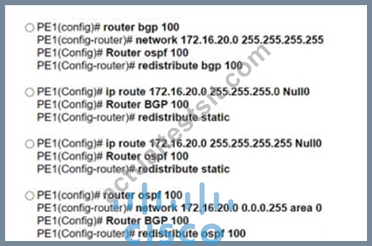
- A. Option A
- B. Option C
- C. Option D
- D. Option B
Answer: D
NEW QUESTION # 159
What is enabled by default on Cisco IOS-XR routers and cannot be disabled?
- A. CDP
- B. Multicast routing
- C. IPv4 and IPv6 CEF
- D. IPv6 routing
- E. BFD
- F. SSH server
Answer: C
NEW QUESTION # 160
Refer to the exhibit. Routers R1 and R2 reside in AS 65530, which is multihomed to the Internet.
A network engineer expects devices in the AS to use R2 to access the Internet, but they are using R1 as the exit point from the AS. Which action corrects the problem?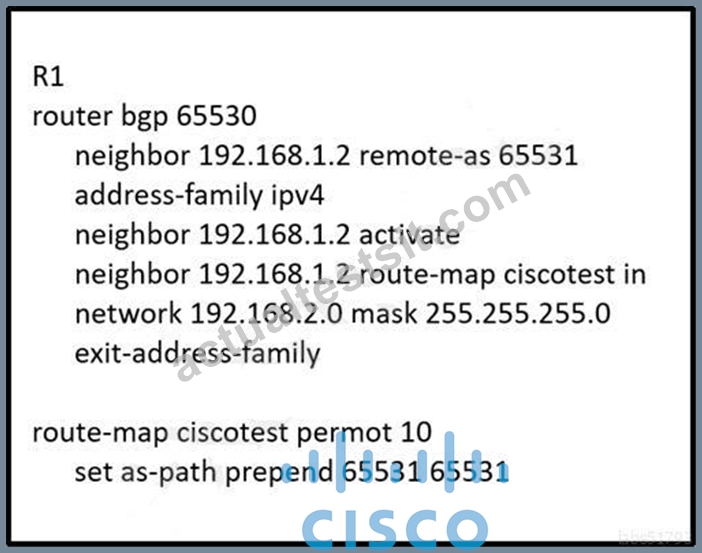
- A. Remove the neighbor statements from the address family configuration and activate the neighbor globally on R1.
- B. Change the route map direction in the neighbor statement to out.
- C. Add a sequence number to the route map to remove the implicit deny.
- D. Configure the route map with a local preference of 200 or higher.
Answer:
Explanation:
https://community.cisco.com/t5/networking-blogs/bgp-as-path-prepending-configuration/ba- p/3819334
NEW QUESTION # 161
Refer to the exhibit. AJI four routers on the network reside in the same data center. The four routers are running IS-IS between them in Level 1 mode within an IPv4 network. After a network engineer installed several new servers connected to R4, users connected via R1 reported they could not connect to applications on the servers. The engineer has determined that R4 is receiving routes from R3 but it is failing to receive routes from R1. Which action must the engineer take to resolve the issue?
- A. Configure R2 only to be a Level 2 router
- B. Configure R2 and R3 to be Level 1/Level 2 routers
- C. Configure R3 only lo be a Level /Level 2 router
- D. Configure R1 and R4 to be Level 2 routers
Answer: B
NEW QUESTION # 162
Refer to the exhibit.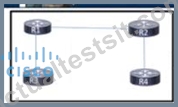
Refer to the exhibit. Unified MPLS is implemented on this network to provide end-to-end services A network engineer noticed that R3 is failing to receive labels from R1 However, R2 is receiving labels from R1 R3 can ping R1 normally Which action resolves the issue?
- A. Add the send-label keyword in the R1 neighbor statement for R3.
- B. Configure R1 to run Unified MPLS on both interfaces.
- C. Add the cdp run command to the link configuration between R1 and R3.
- D. Disable mpls Ip on the link between R1 and R3
Answer: A
NEW QUESTION # 163
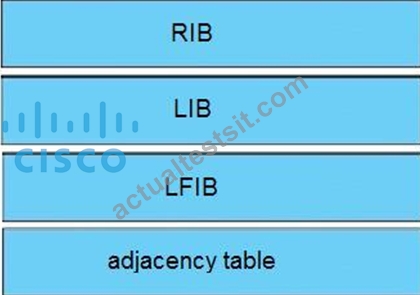
An engineer is troubleshooting end-to-end customer traffic across an MPLS VPN service provider network.
Which tasks should the engineer use to solve the routing issues? Drag and drop the table types from the left onto the most useful troubleshooting tasks/router types on the right. (Not all options are used.)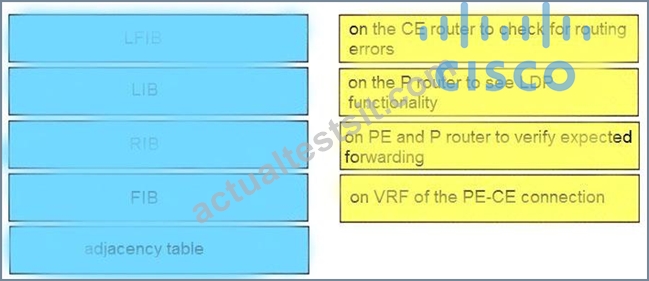
Answer:
Explanation: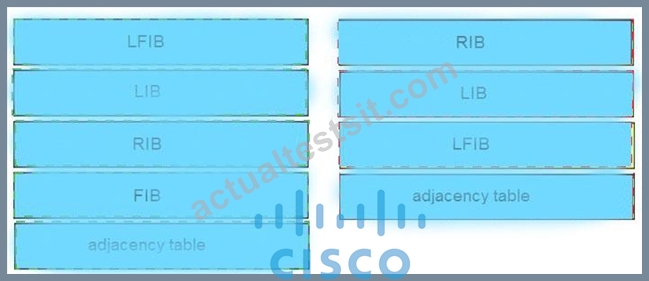
NEW QUESTION # 164
Refer to the exhibit.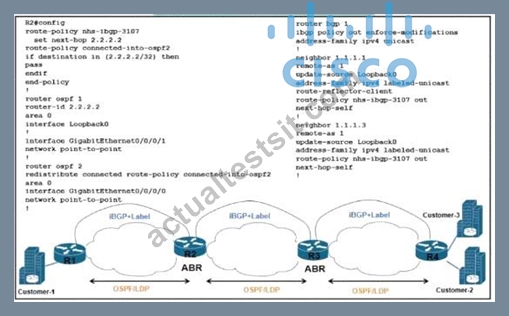
There is a connectivity issue between Customer-1 and Customer-2 File servers between the customers cannot send critical data R3 routes are missing from the routing table on the Customer-1 router All interlaces on Customer-1 are up Which configuration must be applied to router R2 to correct the problem?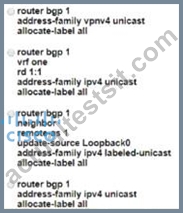
- A. Option A
- B. Option C
- C. Option D
- D. Option B
Answer: C
NEW QUESTION # 165
Refer to the exhibit.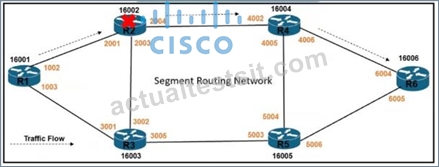
Traffic flow from router R1 to router R6 is delay-sensitive It must consider potential link-failure and node-failure conditions Which configuration must an engineer apply to router R1 to route traffic to router R6 if router R2 fails?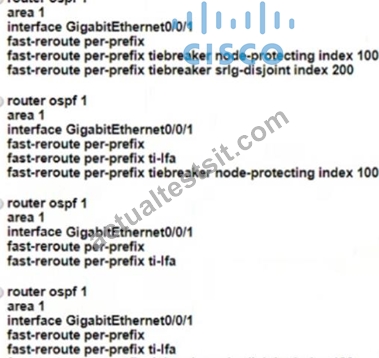
- A. Option A
- B. Option C
- C. Option D
- D. Option B
Answer: D
NEW QUESTION # 166
SIMULATION
Guidelines
This is a lab item in which tasks will be performed on virtual devices.
- Refer to the Tasks tab to view the tasks for this lab item.
- Refer to the Topology tab to access the device console(s) and perform the tasks.
- Console access is available for all required devices by clicking the device icon or using the tab(s) above the console window.
- All necessary preconfigurations have been applied.
- Do not change the enable password or hostname for any device.
- Save your configurations to NVRAM before moving to the next item.
- Click Next at the bottom of the screen to submit this lab and move to the next question.
- When Next is clicked, the lab closes and cannot be reopened.
Topology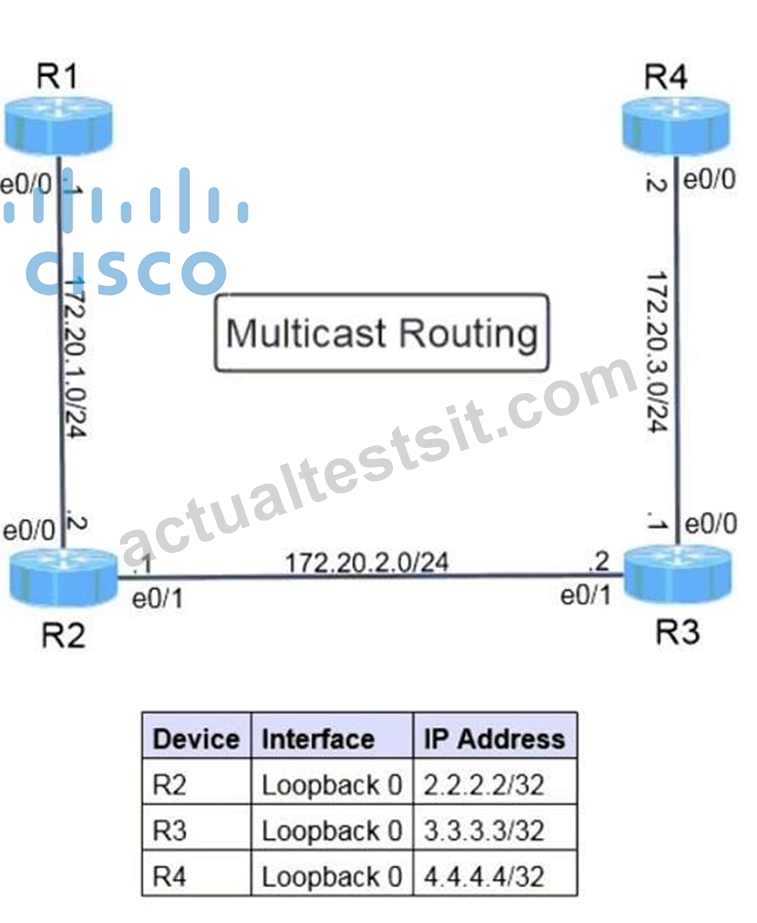
Tasks
R2 and R3 are routers that perform multicast operations. Candidates are required to perform the below configuration and verification tasks on R1 and R2.
1. Configure R2 and R3 to be able to process, route and forward multicast packets.
2. Configure R3 as the root of the shared tree for the any source multicast domain.
3. Configure R1 as the receiver for group 239.100.100.1 and ensure a ping to that group from R4 is successful.
Initial configuration with IP addressing has been completed. The candidate must not make any changes to the configurations except to fulfill the tasks listed above. Use non-proprietary protocol where needed. Only use the provided logical interface for the applicable task.
Answer:
Explanation:
1. Enable Multicast Routing on R2 and R3
To process, route, and forward multicast packets, multicast routing must be enabled globally, and PIM (Protocol Independent Multicast) must be configured on the appropriate interfaces.
Commands on R2 and R3:
R2(config)# ip multicast-routing
R2(config)# interface e0/0
R2(config-if)# ip pim sparse-mode
R2(config)# interface e0/1
R2(config-if)# ip pim sparse-mode
R2(config)# interface loopback 0
R2(config-if)# ip pim sparse-mode
R3(config)# ip multicast-routing
R3(config)# interface e0/0
R3(config-if)# ip pim sparse-mode
R3(config)# interface e0/1
R3(config-if)# ip pim sparse-mode
R3(config)# interface loopback 0
R3(config-if)# ip pim sparse-mode
ip multicast-routing enables multicast routing globally.
ip pim sparse-mode enables PIM in Sparse Mode on interfaces.
2. Configure R3 as the Root of the Shared Tree (Rendezvous Point - RP)
To configure R3 as the RP for the multicast domain, use Auto-RP or Static RP. Here, we configure Static RP for group 239.100.100.1.
Commands on R2 and R3:
R2(config)# ip pim rp-address 3.3.3.3
R3(config)# ip pim rp-address 3.3.3.3
ip pim rp-address <RP-IP>: Configures R3's Loopback0 IP (3.3.3.3) as the RP for the multicast domain.
3. Configure R1 as the Receiver for Group 239.100.100.1
To configure R1 as a multicast receiver, enable IGMP (Internet Group Management Protocol) on R1's e0/0 interface.
Commands on R1:
R1(config)# interface e0/0
R1(config-if)# ip igmp join-group 239.100.100.1
ip igmp join-group <group>: Forces R1 to join the multicast group 239.100.100.1.
Verification: Ensure Ping to Group 239.100.100.1 is Successful from R4
To verify multicast group reachability:
1. Send Multicast Traffic from R4:
R4# ping 239.100.100.1 repeat 5
2. Verify Multicast Routing Table on R2 and R3:
R2# show ip mroute
R3# show ip mroute
3. Verify IGMP Group Membership on R1:
R1# show ip igmp groups
Complete Summary of Configurations:
1. R2 Configuration:
ip multicast-routing
interface e0/0
ip pim sparse-mode
interface e0/1
ip pim sparse-mode
interface loopback 0
ip pim sparse-mode
ip pim rp-address 3.3.3.3
2. R3 Configuration:
ip multicast-routing
interface e0/0
ip pim sparse-mode
interface e0/1
ip pim sparse-mode
interface loopback 0
ip pim sparse-mode
ip pim rp-address 3.3.3.3
3. R1 Configuration:
interface e0/0
ip igmp join-group 239.100.100.1
Verification Checklist:
1. R3 is the RP: Use show ip pim rp mapping..
2. R1 is a Group Member: Verify with show ip igmp groups.
3. Multicast Traffic Flows: Use ping 239.100.100.1 from R4 and verify success.
NEW QUESTION # 167
Refer to the exhibit.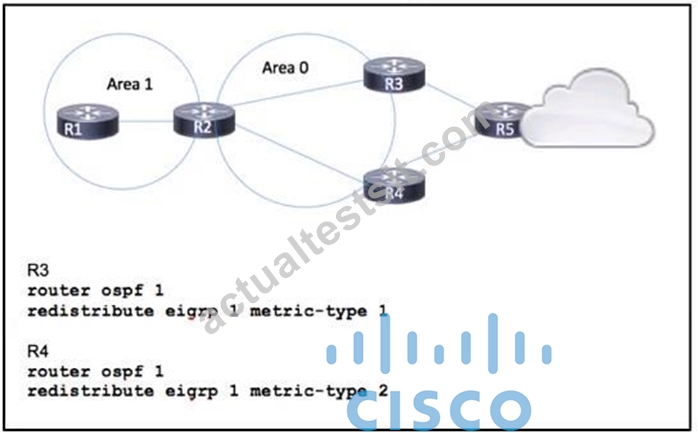
Routers R1, R2. R3, and R4 have been configured to run OSPF. and router R5 is running EIGRP Traffic from R1 to R5 is expected to pass via R4. but OSPF routing has calculated the best path via R3. Which action corrects the problem?
- A. Reconfigure R1 in Area 0.
- B. Configure R1 with a static route to the R5 networks and set R5 as the next hop.
- C. Configure R3 to use metric-type 1 with a higher metric than R4.
- D. Change the metric-type value on R3 to 2.
Answer: D
NEW QUESTION # 168
Refer to the exhibit. A network engineer configured routers R1 and R5 to run in IS-IS Level 1 mode and router R6 to run in IS-IS Level 2 mode. All other routers are running as Level 1 / Level
2 routers. An engineer expects traffic from R1 to R6 to pass via R2, but IS-IS routing has calculated the best path via R4. Which action corrects the problem?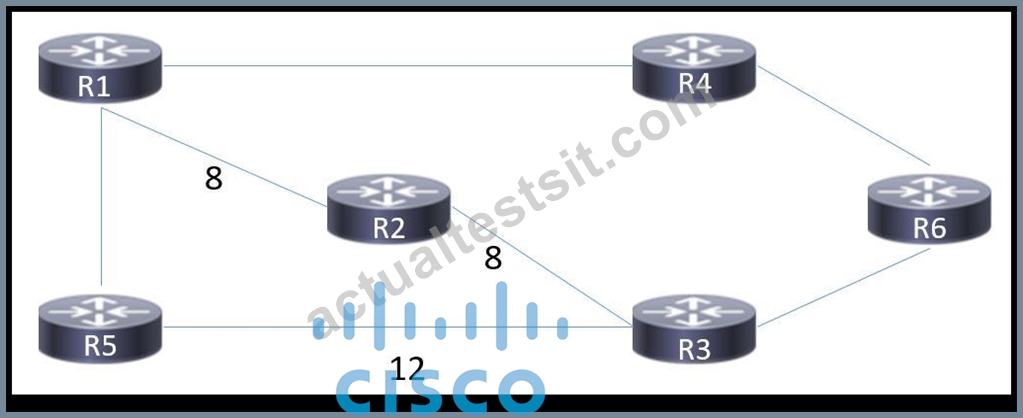
- A. Configure all routers as Level 1 routers.
- B. Configure all routers as Level 1 / Level 2 routers.
- C. Change the link metric for the link from router R1 to router R2 to 1.
- D. Remove the link metric for the link from router R1 to router R2.
Answer: C
Explanation:
The default link metric for IS-IS is 10, so changing the link from R1 to R2 to 1 will change the overall metric to R6 to 9 (8+1).
NEW QUESTION # 169
Refer to the exhibit.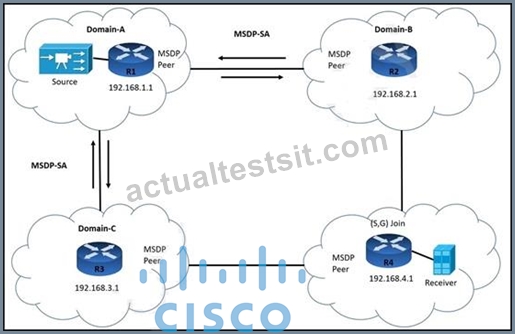
R3 is:
failing to accept multicast RP information from Domain-A
advertising MSDP SA messages to R1 and R4
receiving SA messages only from R4
Which command must the engineer implement to resolve the issue?
- A. R3# ip msdp sa-filter in 192.168.3.1
- B. R3# no ip msap sa-filter in 192.168.1.1
C R3# no ip msdp peer 192.168.1.1 - C. R3# ip msdp sa-filter out 192.168.1.1
Answer: B
NEW QUESTION # 170
Refer to the exhibit.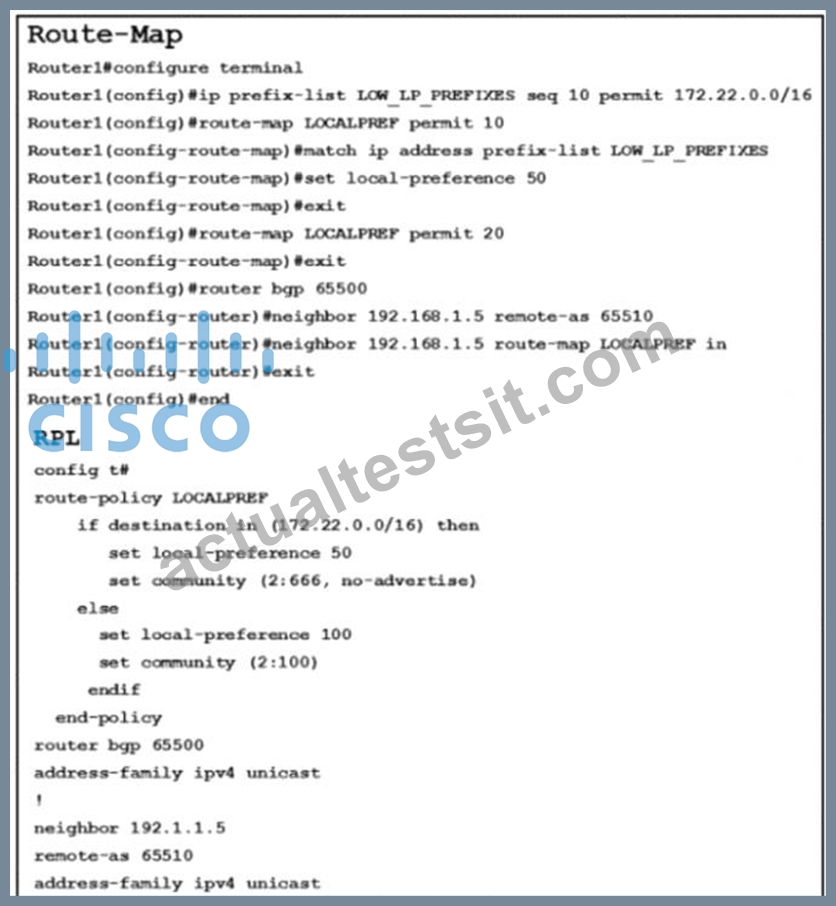
An engineer is comparing these RPL and route map configurations. Which two conclusions will the engineer reach? (Choose two.)
- A. RPL and the route map are applying only local preference 50 for prefix 172.22.0.0/16.
- B. RPL is applying local preference 50 and community (2:666) for prefix 172.22.0.0716. but the route map is applying only local preference 50 for the same prefix
- C. RPL is applying policy only on BGP IPv6 address families, but the route map is applying policy on BGP IPv4 and IPv6 address families.
- D. RPL is applying local preference 50 and community (2:666) for all prefixes, but the route map is applying only local preference 50 for all prefixes.
- E. RPL is applying local preference 100 and community (2:100) for multiple prefixes, but the route map is applying default local preference for multiple prefixes
Answer: B,E
NEW QUESTION # 171
Refer to the exhibit. An engineer has configured all routers in the environment to run IS-IS Level 1 and Level 2 routing. The engineer wants traffic from R1 to R5 to pass via R2. but IS-IS routing has calculated the best path via R4. Which action corrects the problem?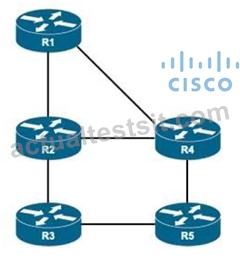
- A. Set the link metric on R2 for the links from router R2 to routers R3 and R4 to 30 or more.
- B. Configure routers R1, R2, and R5 for Level 1 routing only.
- C. Set the link metric for the link from router R1 to router R4 to 30 or more.
- D. Configure routers R1, R4, and R5 for Level 2 routing only.
Answer: C
NEW QUESTION # 172
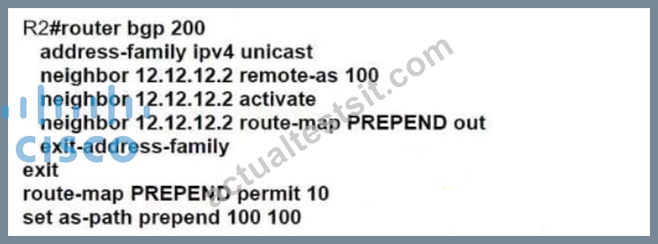
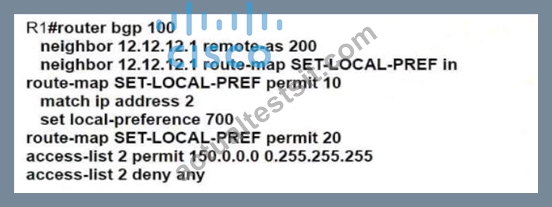
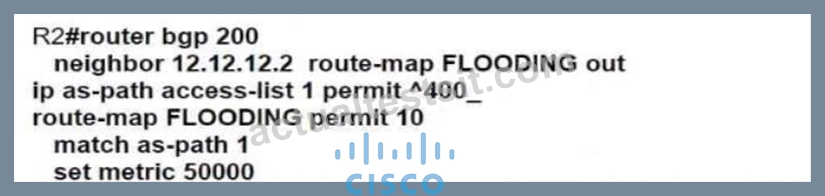
Refer to the exhibit. Excessive routes are flooding from network 150.0.0.0 into AS100. Internet traffic between AS400 and AS300 is working normally. No route controlling mechanism is applied on incoming and outgoing traffic. Which configuration resolves the issue?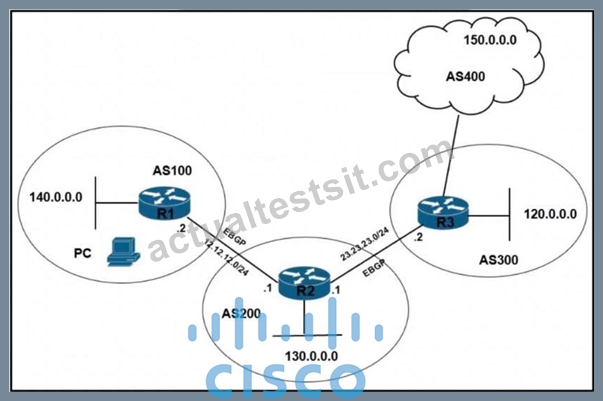
- A.
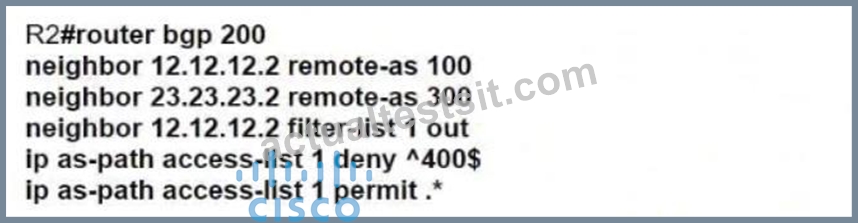
- B.
- C.
- D.
Answer: A
NEW QUESTION # 173 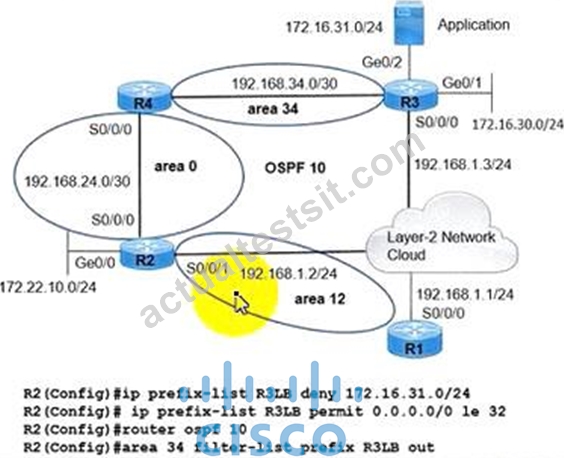
Refer to the exhibit Networks 172.16.31.0/24 and 172 16 30.0/24 are advertised in area 34. and network
172.22 10.0/24 is advertised in area 0. A recent security review discovered that users connected to routers R1 and R2 have been making unauthorized access to an application running on network 172 16 31 0/24 An engineer determined that routers R1 and R2 are receiving updates for network 17 16 31 0/24 Which action resolves the issue?
- A. Apply route filtering on routers RI and R2
- B. Apply route filtering on router R3 only.
- C. Apply route filtering on routers R3 and R4.
- D. Apply route filtering on router R4 only.
Answer: D
NEW QUESTION # 174
Refer to the exhibit.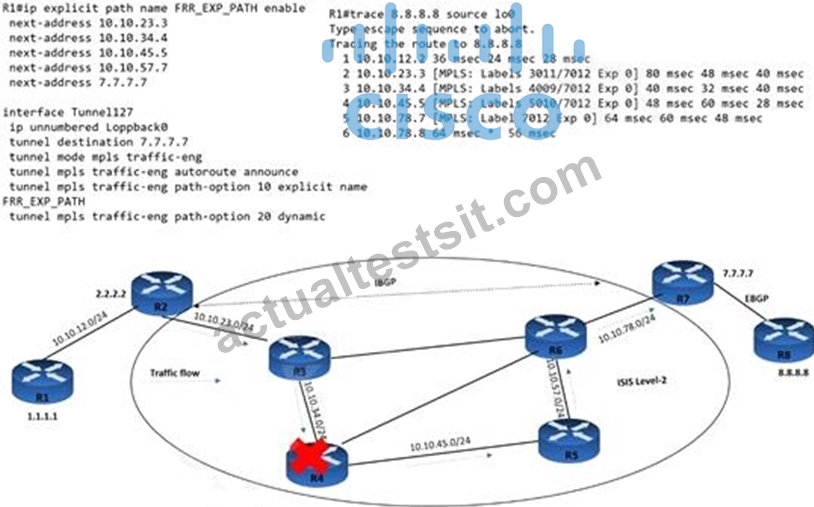
An MPLS core network has connectivity issues R4 has failed. It impacts traffic loss between R1 and R8. Customers report no access to their file servers, which delays their transformation work. Which quick action resolves the issue until R4 recovers?
- A. Disable traffic engineering so that traffic prefers the IGP path
- B. Enable MPLS TE fast reroute on router R1 and Link and Node protection on router R2.
- C. Implement Link and Node protection on routers R2 and R7.
- D. Configure IBGP full mesh for faster convergence.
Answer: B
NEW QUESTION # 175
Refer to the exhibit.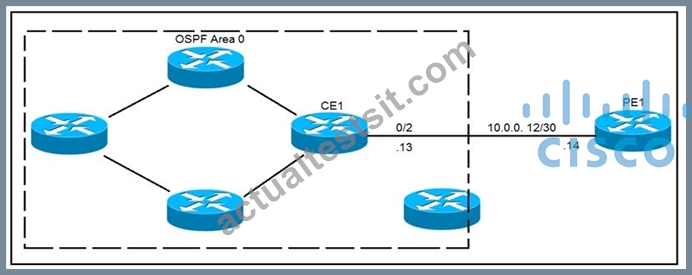
CE1 is the gateway router into the provider network via PE1. A network operator must inject a default route into OSPF area 0. All devices inside area 0 must be able to reach PE1. Which configuration achieves this goal?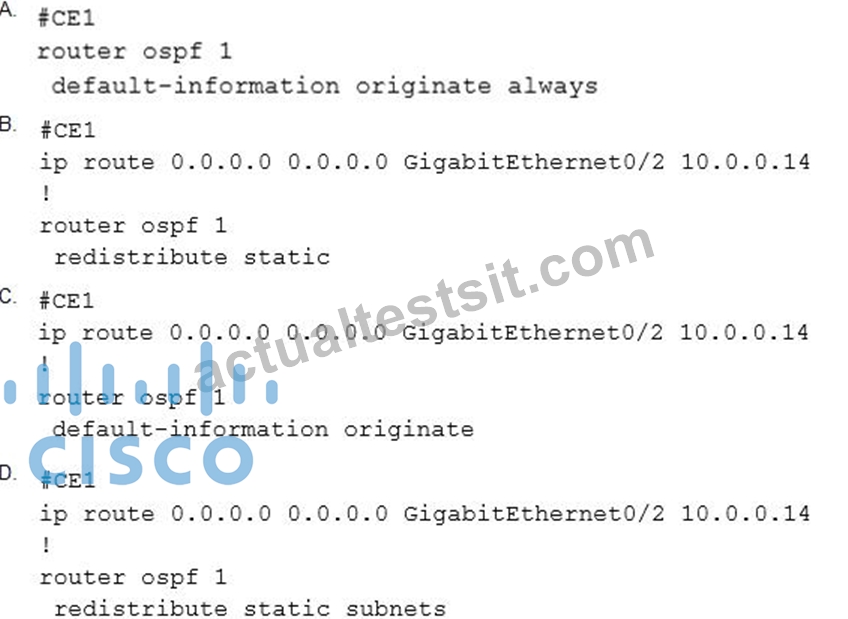
- A. Option C
- B. Option A
- C. Option D
- D. Option B
Answer: A
Explanation:
Reference:
https://www.cisco.com/c/en/us/support/docs/ip/open-shortest-path-first-ospf/47868-ospfdb9.html
NEW QUESTION # 176
......
Cisco 300-510 exam is an excellent way to demonstrate your knowledge and expertise in advanced routing solutions for service provider networks. By passing 300-510 exam and earning your certification, you can take your career to the next level and open up many exciting opportunities in the field of service provider networking.
Latest 100% Passing Guarantee - Brilliant 300-510 Exam Questions PDF: https://2cram.actualtestsit.com/Cisco/300-510-exam-prep-dumps.html