

All Obstacles During ARA-R01 Exam Preparation with ARA-R01 Real Test Questions
Fully Updated Free Actual Snowflake ARA-R01 Exam Questions
NEW QUESTION # 71
Which security, governance, and data protection features require, at a MINIMUM, the Business Critical edition of Snowflake? (Choose two.)
- A. Federated authentication and SSO
- B. Extended Time Travel (up to 90 days)
- C. AWS, Azure, or Google Cloud private connectivity to Snowflake
- D. Periodic rekeying of encrypted data
- E. Customer-managed encryption keys through Tri-Secret Secure
Answer: C,E
Explanation:
According to the SnowPro Advanced: Architect documents and learning resources, the security, governance, and data protection features that require, at a minimum, the Business Critical edition of Snowflake are:
Customer-managed encryption keys through Tri-Secret Secure. This feature allows customers to manage their own encryption keys for data at rest in Snowflake, using a combination of three secrets: a master key, a service key, and a security password. This provides an additional layer of security and control over the data encryption and decryption process1.
Periodic rekeying of encrypted data. This feature allows customers to periodically rotate the encryption keys for data at rest in Snowflake, using either Snowflake-managed keys or customer-managed keys. This enhances the security and protection of the data by reducing the risk of key compromise or exposure2.
The other options are incorrect because they do not require the Business Critical edition of Snowflake. Option A is incorrect because extended Time Travel (up to 90 days) is available with the Enterprise edition of Snowflake3. Option D is incorrect because AWS, Azure, or Google Cloud private connectivity to Snowflake is available with the Standard edition of Snowflake4. Option E is incorrect because federated authentication and SSO are available with the Standard edition of Snowflake5. References: Tri-Secret Secure | Snowflake Documentation, Periodic Rekeying of Encrypted Data | Snowflake Documentation, Snowflake Editions | Snowflake Documentation, Snowflake Network Policies | Snowflake Documentation, Configuring Federated Authentication and SSO | Snowflake Documentation
NEW QUESTION # 72
When loading data into a table that captures the load time in a column with a default value of either CURRENT_TIME () or CURRENT_TIMESTAMP() what will occur?
- A. All rows loaded using a specific COPY statement will have the same timestamp value.
- B. Any rows loaded using a specific COPY statement will have varying timestamps based on when the rows were read from the source.
- C. Any rows loaded using a specific COPY statement will have varying timestamps based on when the rows were created in the source.
- D. All rows loaded using a specific COPY statement will have varying timestamps based on when the rows were inserted.
Answer: A
Explanation:
According to the Snowflake documentation, when loading data into a table that captures the load time in a column with a default value of either CURRENT_TIME () or CURRENT_TIMESTAMP(), the default value is evaluated once per COPY statement, not once per row. Therefore, all rows loaded using a specific COPY statement will have the same timestamp value. This behavior ensures that the timestamp value reflects the time when the data was loaded into the table, not when the data was read from the source or created in the source.
References:
Snowflake Documentation: Loading Data into Tables with Default Values
Snowflake Documentation: COPY INTO table
NEW QUESTION # 73
A company is using a Snowflake account in Azure. The account has SAML SSO set up using ADFS as a SCIM identity provider. To validate Private Link connectivity, an Architect performed the following steps:
* Confirmed Private Link URLs are working by logging in with a username/password account
* Verified DNS resolution by running nslookups against Private Link URLs
* Validated connectivity using SnowCD
* Disabled public access using a network policy set to use the company's IP address range However, the following error message is received when using SSO to log into the company account:
IP XX.XXX.XX.XX is not allowed to access snowflake. Contact your local security administrator.
What steps should the Architect take to resolve this error and ensure that the account is accessed using only Private Link? (Choose two.)
- A. Open a case with Snowflake Support to authorize the Private Link URLs' access to the account.
- B. Generate a new SCIM access token using system$generate_scim_access_token and save it to Azure AD.
- C. Alter the Azure security integration to use the Private Link URLs.
- D. Add the IP address in the error message to the allowed list in the network policy.
- E. Update the configuration of the Azure AD SSO to use the Private Link URLs.
Answer: D,E
Explanation:
The error message indicates that the IP address in the error message is not allowed to access Snowflake because it is not in the allowed list of the network policy. The network policy is a feature that allows restricting access to Snowflake based on IP addresses or ranges. To resolve this error, the Architect should take the following steps:
Add the IP address in the error message to the allowed list in the network policy. This will allow the IP address to access Snowflake using the Private Link URLs. Alternatively, the Architect can disable the network policy if it is not required for security reasons.
Update the configuration of the Azure AD SSO to use the Private Link URLs. This will ensure that the SSO authentication process uses the Private Link URLs instead of the public URLs. The configuration can be updated by following the steps in the Azure documentation1.
These two steps should resolve the error and ensure that the account is accessed using only Private Link. The other options are not necessary or relevant for this scenario. Altering the Azure security integration to use the Private Link URLs is not required because the security integration is used for SCIM provisioning, not for SSO authentication. Generating a new SCIM access token using system$generate_scim_access_token and saving it to Azure AD is not required because the SCIM access token is used for SCIM provisioning, not for SSO authentication. Opening a case with Snowflake Support to authorize the Private Link URLs' access to the account is not required because the authorization can be done by the account administrator using the SYSTEM$AUTHORIZE_PRIVATELINK function2.
NEW QUESTION # 74
How is the change of local time due to daylight savings time handled in Snowflake tasks? (Choose two.)
- A. A frequent task execution schedule like minutes may not cause a problem, but will affect the task history.
- B. A task scheduled in a UTC-based schedule will have no issues with the time changes.
- C. A task will move to a suspended state during the daylight savings time change.
- D. Task schedules can be designed to follow specified or local time zones to accommodate the time changes.
- E. A task schedule will follow only the specified time and will fail to handle lost or duplicated hours.
Answer: B,D
Explanation:
According to the Snowflake documentation1 and the web search results2, these two statements are true about how the change of local time due to daylight savings time is handled in Snowflake tasks. A task is a feature that allows scheduling and executing SQL statements or stored procedures in Snowflake. A task can be scheduled using a cron expression that specifies the frequency and time zone of the task execution.
A task scheduled in a UTC-based schedule will have no issues with the time changes. UTC is a universal time standard that does not observe daylight savings time. Therefore, a task that uses UTC as the time zone will run at the same time throughout the year, regardless of the local time changes1.
Task schedules can be designed to follow specified or local time zones to accommodate the time changes. Snowflake supports using any valid IANA time zone identifier in the cron expression for a task. This allows the task to run according to the local time of the specified time zone, which may include daylight savings time adjustments. For example, a task that uses Europe/London as the time zone will run one hour earlier or later when the local time switches between GMT and BST12.
References:
Snowflake Documentation: Scheduling Tasks
Snowflake Community: Do the timezones used in scheduling tasks in Snowflake adhere to daylight savings?
NEW QUESTION # 75
An Architect is designing a file ingestion recovery solution. The project will use an internal named stage for file storage. Currently, in the case of an ingestion failure, the Operations team must manually download the failed file and check for errors.
Which downloading method should the Architect recommend that requires the LEAST amount of operational overhead?
- A. Use the Snowflake Connector for Python, connect to remote storage and download the file.
- B. Use the get command in Snowsight to retrieve the file.
- C. Use the get command in SnowSQL to retrieve the file.
- D. Use the Snowflake API endpoint and download the file.
Answer: C
Explanation:
The get command in SnowSQL is a convenient way to download files from an internal stage to a local directory. The get command can be used in interactive mode or in a script, and it supports wildcards and parallel downloads. The get command also allows specifying the overwrite option, which determines how to handle existing files with the same name2 The Snowflake Connector for Python, the Snowflake API endpoint, and the get command in Snowsight are not recommended methods for downloading files from an internal stage, because they require more operational overhead than the get command in SnowSQL. The Snowflake Connector for Python and the Snowflake API endpoint require writing and maintaining code to handle the connection, authentication, and file transfer. The get command in Snowsight requires using the web interface and manually selecting the files to download34 References:
1: SnowPro Advanced: Architect | Study Guide
2: Snowflake Documentation | Using the GET Command
3: Snowflake Documentation | Using the Snowflake Connector for Python
4: Snowflake Documentation | Using the Snowflake API
: Snowflake Documentation | Using the GET Command in Snowsight
: SnowPro Advanced: Architect | Study Guide
: Using the GET Command
: Using the Snowflake Connector for Python
: Using the Snowflake API
: [Using the GET Command in Snowsight]
NEW QUESTION # 76
What considerations need to be taken when using database cloning as a tool for data lifecycle management in a development environment? (Select TWO).
- A. Any pipes in the source referring to internal stages are not cloned.
- B. The clone inherits all granted privileges of all child objects in the source object, including the database.
- C. The clone inherits all granted privileges of all child objects in the source object, excluding the database.
- D. Any pipes in the source referring to external stages are not cloned.
- E. Any pipes in the source are not cloned.
Answer: B,E
Explanation:
Database cloning is a feature of Snowflake that allows creating a copy of a database, schema, table, or view without consuming any additional storage space. Database cloning can be used as a tool for data lifecycle management in a development environment, where developers and testers can work on isolated copies of production data without affecting the original data or each other1.
However, there are some considerations that need to be taken when using database cloning in a development environment, such as:
Any pipes in the source are not cloned. Pipes are objects that load data from a stage into a table continuously. Pipes are not cloned because they are associated with a specific stage and table, and cloning them would create duplicate data loading and potential conflicts2.
The clone inherits all granted privileges of all child objects in the source object, including the database.
Privileges are the permissions that control the access and actions that can be performed on an object.
When a database is cloned, the clone inherits all the privileges that were granted on the source database and its child objects, such as schemas, tables, and views. This means that the same roles that can access and modify the source database can also access and modify the clone, unless the privileges are explicitly revoked or modified3.
The other options are not correct because:
B). Any pipes in the source referring to internal stages are not cloned. This is a subset of option A, which states that any pipes in the source are not cloned, regardless of the type of stage they refer to.
C). Any pipes in the source referring to external stages are not cloned. This is also a subset of option A, which states that any pipes in the source are not cloned, regardless of the type of stage they refer to.
E). The clone inherits all granted privileges of all child objects in the source object, excluding the database. This is incorrect, as the clone inherits all granted privileges of the source object, including the database.
References:
1: Database Cloning | Snowflake Documentation
2: Pipes | Snowflake Documentation
3: Access Control Privileges | Snowflake Documentation
NEW QUESTION # 77
A company has an external vendor who puts data into Google Cloud Storage. The company's Snowflake account is set up in Azure.
What would be the MOST efficient way to load data from the vendor into Snowflake?
- A. Ask the vendor to create a Snowflake account, load the data into Snowflake and create a data share.
- B. Create a Snowflake Account in the Google Cloud Platform (GCP), ingest data into this account and use data replication to move the data from GCP to Azure.
- C. Copy the data from Google Cloud Storage to Azure Blob storage using external tools and load data from Blob storage to Snowflake.
- D. Create an external stage on Google Cloud Storage and use the external table to load the data into Snowflake.
Answer: D
Explanation:
The most efficient way to load data from the vendor into Snowflake is to create an external stage on Google Cloud Storage and use the external table to load the data into Snowflake (Option B). This way, you can avoid copying or moving the data across different cloud platforms, which can incur additional costs and latency. You can also leverage the external table feature to query the data directly from Google Cloud Storage without loading it into Snowflake tables, which can save storage space and improve performance. Option A is not efficient because it requires the vendor to create a Snowflake account and a data share, which can be complicated and costly. Option C is not efficient because it involves copying the data from Google Cloud Storage to Azure Blob storage using external tools, which can be slow and expensive. Option D is not efficient because it requires creating a Snowflake account in the Google Cloud Platform (GCP), ingesting data into this account, and using data replication to move the data from GCP to Azure, which can be complex and time-consuming. References: The answer can be verified from Snowflake's official documentation on external stages and external tables available on their website. Here are some relevant links:
Using External Stages | Snowflake Documentation
Using External Tables | Snowflake Documentation
Loading Data from a Stage | Snowflake Documentation
NEW QUESTION # 78
What are characteristics of the use of transactions in Snowflake? (Select TWO).
- A. A transaction can be started explicitly by executing a begin transaction statement and end explicitly by executing an end transaction statement.
- B. Explicit transactions should contain only DML statements and query statements. All DDL statements implicitly commit active transactions.
- C. A transaction can be started explicitly by executing a begin work statement and end explicitly by executing a commit work statement.
- D. Explicit transactions can contain DDL, DML, and query statements.
- E. The autocommit setting can be changed inside a stored procedure.
Answer: A,D
Explanation:
In Snowflake, a transaction is a sequence of SQL statements that are processed as an atomic unit. All statements in the transaction are either applied (i.e. committed) or undone (i.e. rolled back) together.
Snowflake transactions guarantee ACID properties. A transaction can include both reads and writes1.
Explicit transactions are transactions that are started and ended explicitly by using the BEGIN TRANSACTION, COMMIT, and ROLLBACK statements. Snowflake supports the synonyms BEGIN WORK and BEGIN TRANSACTION, and COMMIT WORK and ROLLBACK WORK. Explicit transactions can contain DDL, DML, and query statements. However, explicit transactions should contain only DML statements and query statements, because DDL statements implicitly commit active transactions. This means that any changes made by the previous statements in the transaction are applied, and any changes made by the subsequent statements in the transaction are not part of the same transaction1.
The other options are not correct because:
B). The autocommit setting can be changed inside a stored procedure, but this does not affect the use of transactions in Snowflake. The autocommit setting determines whether each statement is executed in its own implicit transaction or not. If autocommit is enabled, each statement is committed automatically. If autocommit is disabled, each statement is executed in an implicit transaction until an explicit COMMIT or ROLLBACK is issued. Changing the autocommit setting inside a stored procedure only affects the statements within the stored procedure, and does not affect the statements outside the stored procedure2.
C). A transaction can be started explicitly by executing a BEGIN WORK statement and end explicitly by executing a COMMIT WORK statement, but this is not a characteristic of the use of transactions in Snowflake. This is just one way of writing the statements that start and end an explicit transaction. Snowflake also supports the synonyms BEGIN TRANSACTION and COMMIT, which are recommended over BEGIN WORK and COMMIT WORK1.
D). A transaction can be started explicitly by executing a BEGIN TRANSACTION statement and end explicitly by executing an END TRANSACTION statement, but this is not a valid syntax in Snowflake.
Snowflake does not support the END TRANSACTION statement. The correct way to end an explicit transaction is to use the COMMIT or ROLLBACK statement1.
References:
1: Transactions | Snowflake Documentation
2: AUTOCOMMIT | Snowflake Documentation
NEW QUESTION # 79
A table for IOT devices that measures water usage is created. The table quickly becomes large and contains more than 2 billion rows.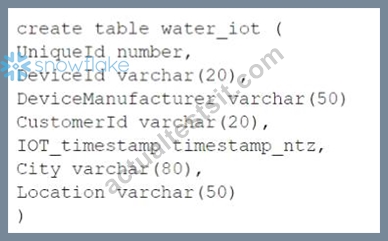
The general query patterns for the table are:
1. DeviceId, lOT_timestamp and Customerld are frequently used in the filter predicate for the select statement
2. The columns City and DeviceManuf acturer are often retrieved
3. There is often a count on Uniqueld
Which field(s) should be used for the clustering key?
- A. Deviceld and Customerld
- B. City and DeviceManuf acturer
- C. lOT_timestamp
- D. Uniqueld
Answer: A
Explanation:
A clustering key is a subset of columns or expressions that are used to co-locate the data in the same micro-partitions, which are the units of storage in Snowflake. Clustering can improve the performance of queries that filter on the clustering key columns, as it reduces the amount of data that needs to be scanned. The best choice for a clustering key depends on the query patterns and the data distribution in the table. In this case, the columns DeviceId, IOT_timestamp, and CustomerId are frequently used in the filter predicate for the select statement, which means they are good candidates for the clustering key. The columns City and DeviceManufacturer are often retrieved, but not filtered on, so they are not as important for the clustering key.
The column UniqueId is used for counting, but it is not a good choice for the clustering key, as it is likely to have a high cardinality and a uniform distribution, which means it will not help to co-locate the data.
Therefore, the best option is to use DeviceId and CustomerId as the clustering key, as they can help to prune the micro-partitions and speed up thequeries. References: Clustering Keys & Clustered Tables, Micro-partitions & Data Clustering, A Complete Guide to Snowflake Clustering
NEW QUESTION # 80
Following objects can be cloned in snowflake
- A. Permanent table
- B. External tables
- C. Transient table
- D. Temporary table
- E. Internal stages
Answer: A,B,C
Explanation:
Snowflake supports cloning of various objects, such as databases, schemas, tables, stages, file formats, sequences, streams, tasks, and roles. Cloning creates a copy of an existing object inthe system without copying the data or metadata. Cloning is also known as zero-copy cloning1.
Among the objects listed in the question, the following ones can be cloned in Snowflake:
Permanent table: A permanent table is a type of table that has a Fail-safe period and a Time Travel retention period of up to 90 days. A permanent table can be cloned using the CREATE TABLE ...
CLONE command2. Therefore, option A is correct.
Transient table: A transient table is a type of table that does not have a Fail-safe period and can have a Time Travel retention period of either 0 or 1 day. A transient table can also be cloned using the CREATE TABLE ... CLONE command2. Therefore, option B is correct.
External table: An external table is a type of table that references data files stored in an external location, such as Amazon S3, Google Cloud Storage, or Microsoft Azure Blob Storage. An external table can be cloned using the CREATE EXTERNAL TABLE ... CLONE command3.
Therefore, option D is correct.
The following objects listed in the question cannot be cloned in Snowflake:
Temporary table: A temporary table is a type of table that is automatically dropped when the session ends or the current user logs out. Temporary tables do not support cloning4. Therefore, option C is incorrect.
Internal stage: An internal stage is a type of stage that is managed by Snowflake and stores files in Snowflake's internal cloud storage. Internal stages do not support cloning5. Therefore, option E is incorrect.
References: : Cloning Considerations : CREATE TABLE ... CLONE : CREATE EXTERNAL TABLE ...
CLONE : Temporary Tables : Internal Stages
NEW QUESTION # 81
A Snowflake Architect is designing a multiple-account design strategy.
This strategy will be MOST cost-effective with which scenarios? (Select TWO).
- A. The company needs to share data between two databases, where one must support Payment Card Industry Data Security Standard (PCI DSS) compliance but the other one does not.
- B. The company must use a specific network policy for certain users to allow and block given IP addresses.
- C. The company needs to support different role-based access control features for the development, test, and production environments.
- D. The company wants to clone a production database that resides on AWS to a development database that resides on Azure.
- E. The company security policy mandates the use of different Active Directory instances for the development, test, and production environments.
Answer: A,C
Explanation:
A multiple-account design strategy is a way of organizing Snowflake accounts into logical groups based on different criteria, such as cloud provider, region, environment, or business unit. A multiple-account design strategy can help achieve various goals, such as cost optimization, performance isolation, security compliance, and data sharing1. In this question, the scenarios that would be most cost-effective with a multiple-account design strategy are:
The company wants to clone a production database that resides on AWS to a development database that resides on Azure. This scenario would benefit from a multiple-account design strategy because it would allow the company to leverage the cross-cloud replication feature of Snowflake, which enables replicating databases across different cloud platforms and regions. This feature can help reduce the data transfer costs and latency, as well as provide high availability and disaster recovery2.
The company security policy mandates the use of different Active Directory instances for the development, test, and production environments. This scenario would benefit from a multiple-account design strategy because it would allow the company to use different federated authentication methods for each environment, and integrate them with different Active Directory instances. This can help improve the security and governance of the access to the Snowflake accounts, as well as simplify the user management and provisioning3.
The other scenarios would not be most cost-effective with a multiple-account design strategy, because:
The company needs to share data between two databases, where one must support Payment Card Industry Data Security Standard (PCI DSS) compliance but the other one does not. This scenario can be handled within a single Snowflake account, by using secure views and secure UDFs to mask or filter the sensitive data, and applying the appropriate roles and privileges to the users who access the data. This can help achieve the PCI DSS compliance without incurring the additional costs of managing multiple accounts4.
The company needs to support different role-based access control features for the development, test, and production environments. This scenario can also be handled within a single Snowflake account, by using the native role-based access control (RBAC) features of Snowflake, such as roles, grants, and privileges, to define different access levels and permissions for each environment. This can help ensure the security and integrity of the data and the objects, as well as the separation of duties and responsibilities among the users.
The company must use a specific network policy for certain users to allow and block given IP addresses.
This scenario can also be handled within a single Snowflake account, by using the network policy feature of Snowflake, which enables creating and applying network policies to restrict the IP addresses that can access the Snowflake account. This can help prevent unauthorized access and protect the data from malicious attacks.
References:
Designing Your Snowflake Topology
Cross-Cloud Replication
Configuring Federated Authentication and SSO
Using Secure Views and Secure UDFs to Comply with PCI DSS
[Understanding Access Control in Snowflake]
[Network Policies]
NEW QUESTION # 82
An Architect needs to automate the daily Import of two files from an external stage into Snowflake. One file has Parquet-formatted data, the other has CSV-formatted data.
How should the data be joined and aggregated to produce a final result set?
- A. Create a task using Snowflake scripting that will import the files, and then call a User-Defined Function (UDF) to produce the final result set.
- B. Create a materialized view to read, Join, and aggregate the data directly from the external stage, and use the view to produce the final result set
- C. Create a JavaScript stored procedure to read. join, and aggregate the data directly from the external stage, and then store the results in a table.
- D. Use Snowpipe to ingest the two files, then create a materialized view to produce the final result set.
Answer: A
Explanation:
According to the Snowflake documentation, tasks are objects that enable scheduling and execution of SQL statements or JavaScript user-defined functions (UDFs) in Snowflake. Tasks can be used to automate data loading, transformation, and maintenance operations. Snowflake scripting is a feature that allows writing procedural logic using SQL statements and JavaScript UDFs. Snowflake scripting can be used to create complex workflows and orchestrate tasks. Therefore, the best option to automate the daily import of two files from an external stage into Snowflake, join and aggregate the data, and produce a final result set is to create a task using Snowflake scripting that will import the files using the COPY INTO command, and then call a UDF to perform the join and aggregation logic. The UDF can return a table or a variant value as the final result set. References:
Tasks
Snowflake Scripting
User-Defined Functions
NEW QUESTION # 83
A Snowflake Architect created a new data share and would like to verify that only specific records in secure views are visible within the data share by the consumers.
What is the recommended way to validate data accessibility by the consumers?
- A. Create reader accounts as shown below and impersonate the consumers by logging in with their credentials.
create managed account reader_acctl admin_name = userl , adroin_password 'Sdfed43da!44T , type = reader; - B. Set the session parameter called SIMULATED_DATA_SHARING_C0NSUMER as shown below in order to impersonate the consumer accounts.
alter session set simulated_data_sharing_consumer - 'Consumer Acctl* - C. Alter the share settings as shown below, in order to impersonate a specific consumer account.
alter share sales share set accounts = 'Consumerl' share restrictions = true - D. Create a row access policy as shown below and assign it to the data share.
create or replace row access policy rap_acct as (acct_id varchar) returns boolean -> case when
'acctl_role' = current_role() then true else false end;
Answer: B
Explanation:
The SIMULATED_DATA_SHARING_CONSUMER session parameter allows a data provider to simulate the data access of a consumer account without creating a reader account or logging in with the consumer credentials. This parameter can be used to validate the data accessibility by the consumers in a data share, especially when using secure viewsor secure UDFs that filter data based on the current account or role. By setting this parameter to the name of a consumer account, the data provider can see the same data as the consumer would see when querying the shared database. This is a convenient and efficient way to test the data sharing functionality and ensure that only the intended data is visible to the consumers.
References:
Using the SIMULATED_DATA_SHARING_CONSUMER Session Parameter
SnowPro Advanced: Architect Exam Study Guide
NEW QUESTION # 84
An Architect on a new project has been asked to design an architecture that meets Snowflake security, compliance, and governance requirements as follows:
1) Use Tri-Secret Secure in Snowflake
2) Share some information stored in a view with another Snowflake customer
3) Hide portions of sensitive information from some columns
4) Use zero-copy cloning to refresh the non-production environment from the production environment To meet these requirements, which design elements must be implemented? (Choose three.)
- A. Create a materialized view.
- B. Use Dynamic Data Masking.
- C. Define row access policies.
- D. Create a secure view.
- E. Use the Enterprise edition of Snowflake.
- F. Use the Business-Critical edition of Snowflake.
Answer: B,D,F
Explanation:
These three design elements are required to meet the security, compliance, and governance requirements for the project.
To use Tri-Secret Secure in Snowflake, the Business Critical edition of Snowflake is required. This edition provides enhanced data protection features, such as customer-managed encryption keys, that are not available in lower editions. Tri-Secret Secure is a feature that combines a Snowflake-maintained key and a customer-managed key to create a composite master key to encrypt the data in Snowflake1.
To share some information stored in a view with another Snowflake customer, a secure view is recommended. A secure view is a view that hides the underlying data and the view definition from unauthorized users. Only the owner of the view and the users who are granted the owner's role can see the view definition and the data in the base tables of the view2. A secure view can be shared with another Snowflake account using a data share3.
To hide portions of sensitive information from some columns, Dynamic Data Masking can be used.
Dynamic Data Masking is a feature that allows applying masking policies to columns to selectively mask plain-text data at query time. Depending on the masking policy conditions and the user's role, the data can be fully or partially masked, or shown as plain-text4.
NEW QUESTION # 85
What is a characteristic of loading data into Snowflake using the Snowflake Connector for Kafka?
- A. The Connector creates and manages its own stage, file format, and pipe objects.
- B. Loads using the Connector will have lower latency than Snowpipe and will ingest data in real time.
- C. The Connector only works in Snowflake regions that use AWS infrastructure.
- D. The Connector works with all file formats, including text, JSON, Avro, Ore, Parquet, and XML.
Answer: A
Explanation:
According to the SnowPro Advanced: Architect documents and learning resources, a characteristic of loading data into Snowflake using the Snowflake Connector for Kafka is that the Connector creates and manages its own stage, file format, and pipe objects. The stage is an internal stage that is used to store the data files from the Kafka topics. The file format is a JSON or Avro file format that is used to parse the data files. The pipe is a Snowpipe object that is used to load the data files into the Snowflake table. The Connector automatically creates and configures these objects based on the Kafka configuration properties, and handles the cleanup and maintenance of these objects1.
The other options are incorrect because they are not characteristics of loading data into Snowflake using the Snowflake Connector for Kafka. Option A is incorrect because the Connector works in Snowflake regions that use any cloud infrastructure, not just AWS. The Connector supports AWS, Azure, and Google Cloud platforms, and can load data across different regions and cloud platforms using data replication2. Option B is incorrect because the Connector does not work with all file formats,only JSON and Avro. The Connector expects the data in the Kafka topics to be in JSON or Avro format, and parses the data accordingly. Other file formats, such as text, ORC, Parquet, or XML, are not supported by the Connector3. Option D is incorrect because loads using the Connector do not have lower latency than Snowpipe, and do not ingest data in real time. The Connector uses Snowpipe to load data into Snowflake, and inherits the same latency and performance characteristics of Snowpipe. The Connector does not provide real-time ingestion, but near real-time ingestion, depending on the frequency and size of the data files4. References: Installing and Configuring the Kafka Connector | Snowflake Documentation, Sharing Data Across Regions and Cloud Platforms | Snowflake Documentation, Overview of the Kafka Connector | Snowflake Documentation, Using Snowflake Connector for Kafka With Snowpipe Streaming | Snowflake Documentation
NEW QUESTION # 86
......
Validate your ARA-R01 Exam Preparation with ARA-R01 Practice Test: https://2cram.actualtestsit.com/Snowflake/ARA-R01-exam-prep-dumps.html