

Use Free CKAD Exam Questions that Stimulates Actual EXAM
Get 100% Real CKAD Free Online Practice Test
The CKAD certification exam is a hands-on, performance-based exam that assesses a candidate's skills in solving real-world problems related to Kubernetes. The exam is conducted on a live Kubernetes cluster, and candidates are required to complete a set of practical tasks within a given time limit. These tasks cover a wide range of topics, including Kubernetes architecture, Kubernetes API objects, pod scheduling, application deployment, and troubleshooting.
NEW QUESTION # 17
Refer to Exhibit.
Task:
1- Update the Propertunel scaling configuration of the Deployment web1 in the ckad00015 namespace setting maxSurge to 2 and maxUnavailable to 59
2- Update the web1 Deployment to use version tag 1.13.7 for the Ifconf/nginx container image.
3- Perform a rollback of the web1 Deployment to its previous version
Answer:
Explanation:
Solution:


NEW QUESTION # 18
Context
Anytime a team needs to run a container on Kubernetes they will need to define a pod within which to run the container.
Task
Please complete the following:
* Create a YAML formatted pod manifest
/opt/KDPD00101/podl.yml to create a pod named app1 that runs a container named app1cont using image Ifccncf/arg-output with these command line arguments: -lines 56 -F
* Create the pod with the kubect1 command using the YAML file created in the previous step
* When the pod is running display summary data about the pod in JSON format using the kubect1 command and redirect the output to a file named /opt/KDPD00101/out1.json
* All of the files you need to work with have been created, empty, for your convenience
Answer:
Explanation:
Solution:


NEW QUESTION # 19
Context
Given a container that writes a log file in format A and a container that converts log files from format A to format B, create a deployment that runs both containers such that the log files from the first container are converted by the second container, emitting logs in format B.
Task:
* Create a deployment named deployment-xyz in the default namespace, that:
* Includes a primary
lfccncf/busybox:1 container, named logger-dev
* includes a sidecar Ifccncf/fluentd:v0.12 container, named adapter-zen
* Mounts a shared volume /tmp/log on both containers, which does not persist when the pod is deleted
* Instructs the logger-dev
container to run the command
which should output logs to /tmp/log/input.log in plain text format, with example values:
* The adapter-zen sidecar container should read /tmp/log/input.log and output the data to /tmp/log/output.* in Fluentd JSON format. Note that no knowledge of Fluentd is required to complete this task: all you will need to achieve this is to create the ConfigMap from the spec file provided at /opt/KDMC00102/fluentd-configma p.yaml , and mount that ConfigMap to /fluentd/etc in the adapter-zen sidecar container
Answer:
Explanation:
Solution:


NEW QUESTION # 20 
Task:
A Dockerfile has been prepared at -/human-stork/build/Dockerfile
1) Using the prepared Dockerfile, build a container image with the name macque and lag 3.0. You may install and use the tool of your choice.
2) Using the tool of your choice export the built container image in OC-format and store it at -/human stork/macque 3.0 tar See the solution below.
Answer:
Explanation:
Explanation
Solution:


NEW QUESTION # 21
Context
Context
You sometimes need to observe a pod's logs, and write those logs to a file for further analysis.
Task
Please complete the following;
* Deploy the counter pod to the cluster using the provided YAMLspec file at /opt/KDOB00201/counter.yaml
* Retrieve all currently available application logs from the running pod and store them in the file /opt/KDOB0020l/log_Output.txt, which has already been created
Answer:
Explanation:
Solution:


NEW QUESTION # 22 
Context
You are tasked to create a secret and consume the secret in a pod using environment variables as follow:
Task
* Create a secret named another-secret with a key/value pair; key1/value4
* Start an nginx pod named nginx-secret using container image nginx, and add an environment variable exposing the value of the secret key key 1, using COOL_VARIABLE as the name for the environment variable inside the pod See the solution below.
Answer:
Explanation:
Explanation
Solution: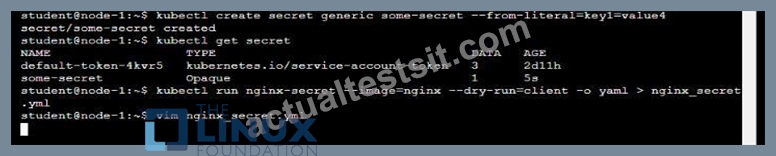


NEW QUESTION # 23 
Context
You sometimes need to observe a pod's logs, and write those logs to a file for further analysis.
Task
Please complete the following;
* Deploy the counter pod to the cluster using the provided YAMLspec file at /opt/KDOB00201/counter.yaml
* Retrieve all currently available application logs from the running pod and store them in the file
/opt/KDOB0020l/log_Output.txt, which has already been created
Answer:
Explanation:
See the solution below.
Explanation
Solution:


NEW QUESTION # 24 
Context
Developers occasionally need to submit pods that run periodically.
Task
Follow the steps below to create a pod that will start at a predetermined time and]which runs to completion only once each time it is started:
* Create a YAML formatted Kubernetes manifest /opt/KDPD00301/periodic.yaml that runs the following shell command: date in a single busybox container. The command should run every minute and must complete within 22 seconds or be terminated oy Kubernetes. The Cronjob namp and container name should both be hello
* Create the resource in the above manifest and verify that the job executes successfully at least once See the solution below.
Answer:
Explanation:
Explanation
Solution:


NEW QUESTION # 25 
Context
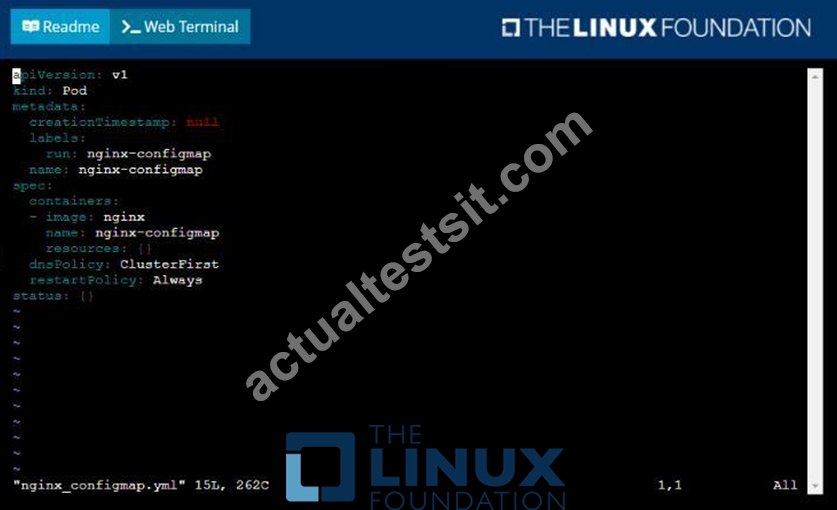
You are tasked to create a ConfigMap and consume the ConfigMap in a pod using a volume mount.
Task
Please complete the following:
* Create a ConfigMap named another-config containing the key/value pair: key4/value3
* start a pod named nginx-configmap containing a single container using the nginx image, and mount the key you just created into the pod under directory /also/a/path See the solution below.
Answer:
Explanation:
Explanation
Solution:


NEW QUESTION # 26
Refer to Exhibit.
Set Configuration Context:
[student@node-1] $ | kubectl
Config use-context k8s
Context
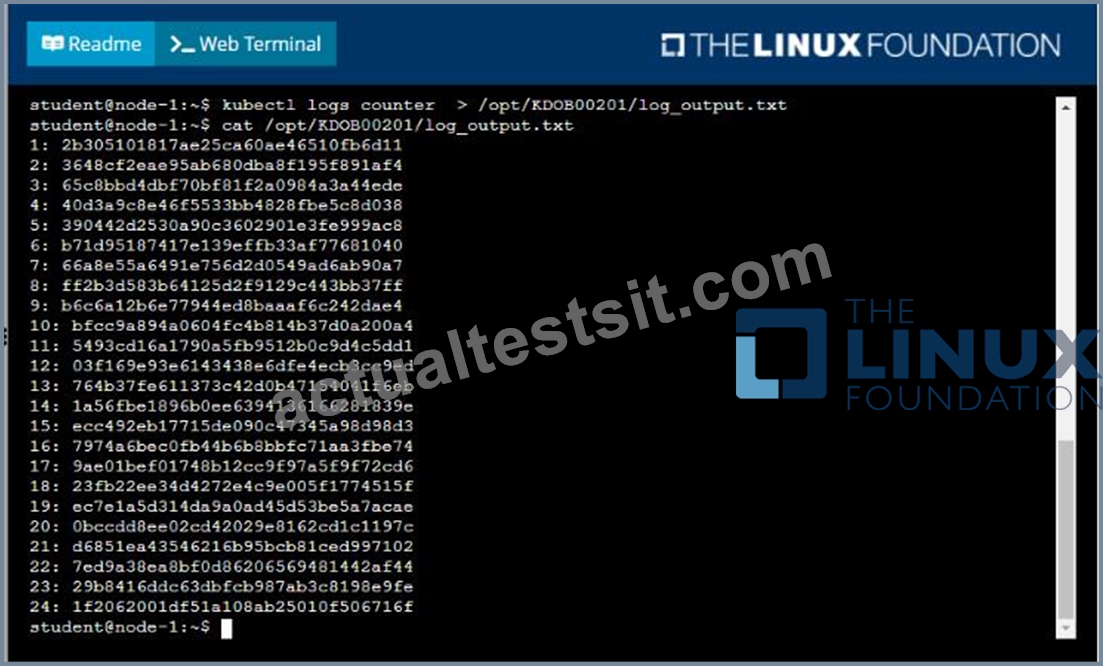
You sometimes need to observe a pod's logs, and write those logs to a file for further analysis.
Task
Please complete the following;
* Deploy the counter pod to the cluster using the provided YAMLspec file at /opt/KDOB00201/counter.yaml
* Retrieve all currently available application logs from the running pod and store them in the file /opt/KDOB0020l/log_Output.txt, which has already been created
Answer:
Explanation:
Solution:
To deploy the counter pod to the cluster using the provided YAML spec file, you can use the kubectl apply command. The apply command creates and updates resources in a cluster.
kubectl apply -f /opt/KDOB00201/counter.yaml
This command will create the pod in the cluster. You can use the kubectl get pods command to check the status of the pod and ensure that it is running.
kubectl get pods
To retrieve all currently available application logs from the running pod and store them in the file /opt/KDOB0020l/log_Output.txt, you can use the kubectl logs command. The logs command retrieves logs from a container in a pod.
kubectl logs -f <pod-name> > /opt/KDOB0020l/log_Output.txt
Replace <pod-name> with the name of the pod.
You can also use -f option to stream the logs.
kubectl logs -f <pod-name> > /opt/KDOB0020l/log_Output.txt &
This command will retrieve the logs from the pod and write them to the /opt/KDOB0020l/log_Output.txt file.
Please note that the above command will retrieve all logs from the pod, including previous logs. If you want to retrieve only the new logs that are generated after running the command, you can add the --since flag to the kubectl logs command and specify a duration, for example --since=24h for logs generated in the last 24 hours.
Also, please note that, if the pod has multiple containers, you need to specify the container name using -c option.
kubectl logs -f <pod-name> -c <container-name> > /opt/KDOB0020l/log_Output.txt The above command will redirect the logs of the specified container to the file.

NEW QUESTION # 27 
Task
You have rolled out a new pod to your infrastructure and now you need to allow it to communicate with the web and storage pods but nothing else. Given the running pod kdsn00201 -newpod edit it to use a network policy that will allow it to send and receive traffic only to and from the web and storage pods.

Answer:
Explanation:
See the solution below.
Explanation
apiVersion: networking.k8s.io/v1
kind: NetworkPolicy
metadata:
name: internal-policy
namespace: default
spec:
podSelector:
matchLabels:
name: internal
policyTypes:
- Egress
- Ingress
ingress:
- {}
egress:
- to:
- podSelector:
matchLabels:
name: mysql
ports:
- protocol: TCP
port: 3306
- to:
- podSelector:
matchLabels:
name: payroll
ports:
- protocol: TCP
port: 8080
- ports:
- port: 53
protocol: UDP
- port: 53
protocol: TCP
NEW QUESTION # 28
Refer to Exhibit.
Context
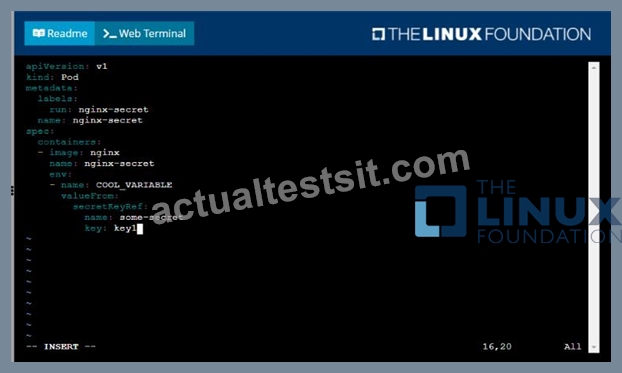
You are tasked to create a secret and consume the secret in a pod using environment variables as follow:
Task
* Create a secret named another-secret with a key/value pair; key1/value4
* Start an nginx pod named nginx-secret using container image nginx, and add an environment variable exposing the value of the secret key key 1, using COOL_VARIABLE as the name for the environment variable inside the pod
Answer:
Explanation:
Solution:


NEW QUESTION # 29
Context
Task:
Update the Deployment app-1 in the frontend namespace to use the existing ServiceAccount app.
Answer:
Explanation:
Solution:
NEW QUESTION # 30
Refer to Exhibit.
Task:
Update the Deployment app-1 in the frontend namespace to use the existing ServiceAccount app.
Answer:
Explanation:
Solution:
NEW QUESTION # 31 
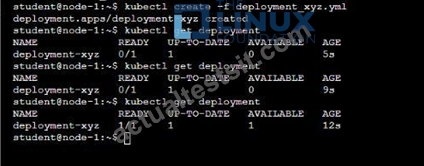
Given a container that writes a log file in format A and a container that converts log files from format A to format B, create a deployment that runs both containers such that the log files from the first container are converted by the second container, emitting logs in format B.
Task:
* Create a deployment named deployment-xyz in the default namespace, that:
*Includes a primary
lfccncf/busybox:1 container, named logger-dev
*includes a sidecar Ifccncf/fluentd:v0.12 container, named adapter-zen
*Mounts a shared volume /tmp/log on both containers, which does not persist when the pod is deleted
*Instructs the logger-dev
container to run the command
which should output logs to /tmp/log/input.log in plain text format, with example values:
* The adapter-zen sidecar container should read /tmp/log/input.log and output the data to /tmp/log/output.* in Fluentd JSON format. Note that no knowledge of Fluentd is required to complete this task: all you will need to achieve this is to create the ConfigMap from the spec file provided at /opt/KDMC00102/fluentd-configma p.yaml , and mount that ConfigMap to /fluentd/etc in the adapter-zen sidecar container See the solution below.
Answer:
Explanation:
Explanation
Solution:


NEW QUESTION # 32
Exhibit:
Task
A deployment is falling on the cluster due to an incorrect image being specified. Locate the deployment, and fix the problem.
- A. Pending
Answer: A
NEW QUESTION # 33
Context
Task:
1) Create a secret named app-secret in the default namespace containing the following single key-value pair:
Key3: value1
2) Create a Pod named ngnix secret in the default namespace.Specify a single container using the nginx:stable image.
Add an environment variable named BEST_VARIABLE consuming the value of the secret key3.
Answer:
Explanation:
Solution:


NEW QUESTION # 34
Exhibit:
Context
You are tasked to create a ConfigMap and consume the ConfigMap in a pod using a volume mount.
Task
Please complete the following:
* Create a ConfigMap named another-config containing the key/value pair: key4/value3
* start a pod named nginx-configmap containing a single container using the
nginx image, and mount the key you just created into the pod under directory /also/a/path
- A. Solution:


- B. Solution:
Answer: A
NEW QUESTION # 35
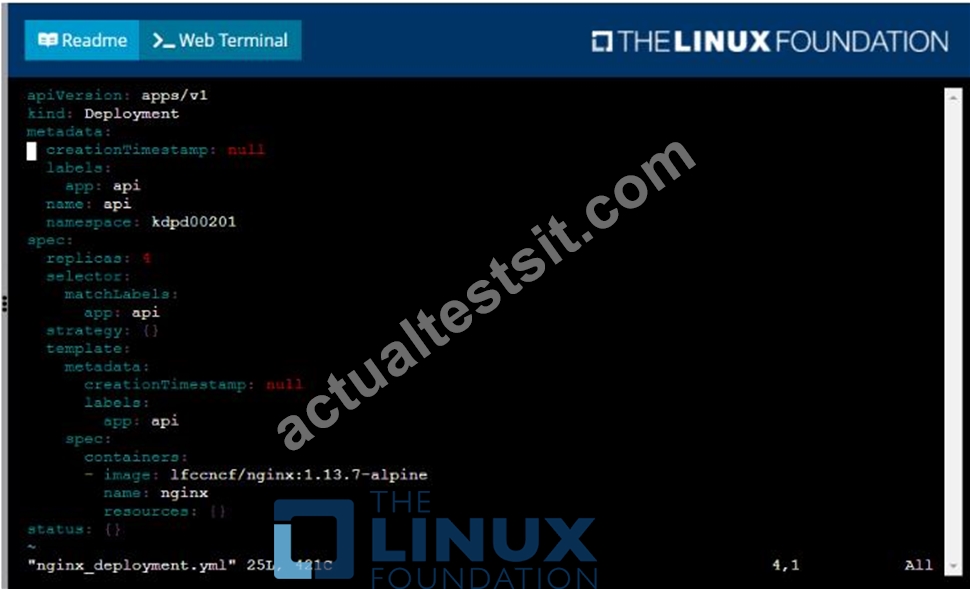
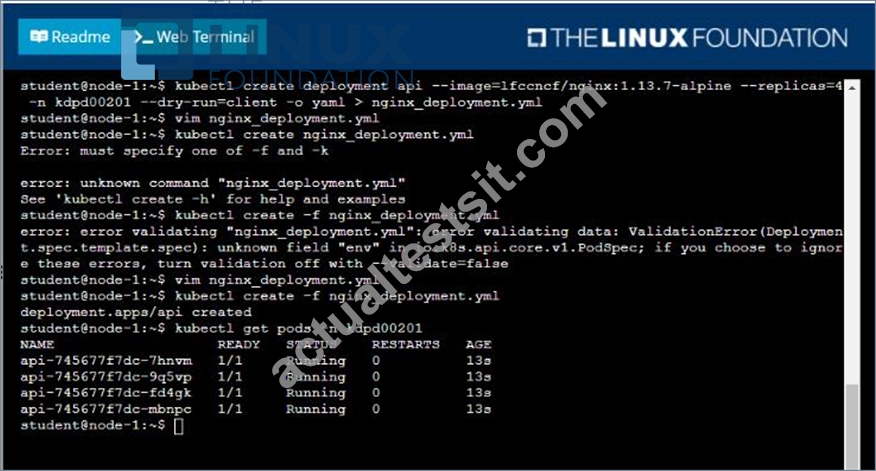
Refer to Exhibit.
Task
Create a new deployment for running.nginx with the following parameters;
* Run the deployment in the kdpd00201 namespace. The namespace has already been created
* Name the deployment frontend and configure with 4 replicas
* Configure the pod with a container image of lfccncf/nginx:1.13.7
* Set an environment variable of NGINX__PORT=8080 and also expose that port for the container above
Answer:
Explanation:
Solution: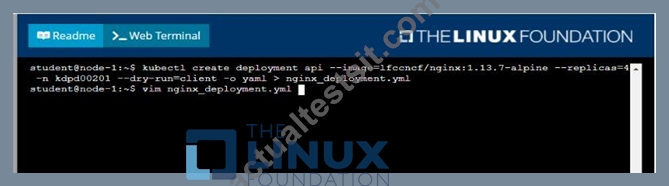

NEW QUESTION # 36
......
BEST Verified Linux Foundation CKAD Exam Questions (2023) : https://2cram.actualtestsit.com/Linux-Foundation/CKAD-exam-prep-dumps.html